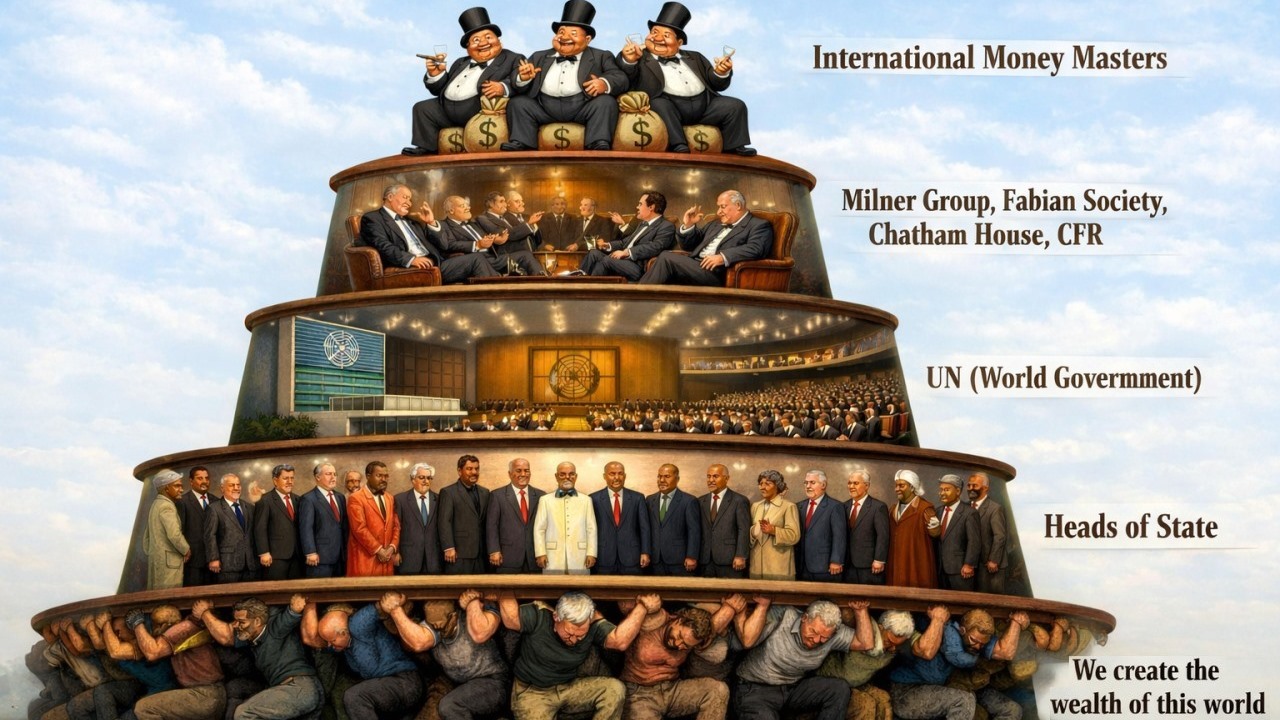
The UN's scam lies in the fact that, under the slogans of "Peace" and "Cooperation", a system of Global Governance was created designed to deprive peoples of the right to independently determine their own future.
A scam is a trick, swindle or fraud (Oxford English Dictionary). It is a scheme that represents a thing as what it is not, particularly for the purpose of cheating others of things that rightfully belong to them, such as money, freedom, identity, etc.
The United Nations' precursor, the League of Nations (LON), was created in 1919 by certain business and political interests represented by the Milner Group and the Fabian Society (Quigley; Pugh; Winkler). The creation of the United Nations was instigated by the same vested interests as those behind the League. For example, the preamble to the UN Charter was written by General Jan Smuts (Mazower, p. 61), a member of the Milner Group (Quigley, p. 48) who had also been involved in the creation of the League of Nations.
In brief, here are some key points which help us understand the fraudulent nature of the UN:
1. As the international economic and political system was dominated by self-appointed elite groups which exploited it for their own ends, the organization they created was not one working for the common good of the human race, but one serving the interests of the elites who created and dominated or controlled it.
2. Like its predecessor, the UN was created as an instrument for world government.
3. The UN was not based on equality among nations. Germany, a major European nation, was excluded from the permanent members group even after the war. Indeed, like the League of Nations the UN was conceived as an anti-German organization, the phrase "United Nations" being first applied to Germany's Allied opponents in World War II. As a result, the UN became a new system of oppression in which Germany and Eastern Europe were subordinated to foreign interests and turned into virtual colonies of Communist Russia and its Western allies (the division of East and Central Europe into Russian and other "spheres of influence" was engineered at Yalta in 1945 along with the UN plan).
4. The UN's five permanent members, Britain, USA, Russia, China and France, are among the world's largest arms exporting countries (including to rogue states) - which severely undermines the UN's claim to being an organization working for "world peace".
THE ORIGINS OF THE UN
The idea of world organization originated in the left-wing internationalism of the late 1800s (in 1888, Karl Marx's collaborator Wilhelm Liebknecht spoke of a "United States of Europe and of the World") and began to take root in Liberal and, in particular, Labour circles (Winkler, p. 4). In the early 1900s, it was still regarded as radical and normally associated with Socialism or Fabianism (Mazower, p. 39). Indeed, as noted above, it was leftwing groups like the Milner Group and the Fabian Society who took it up and put it into practice with the creation of the League of Nations. While Milnerites stressed closer association with America, Fabians were particularly keen on closer ties with Soviet Russia.
Russia was a large country with important natural resources, which international business interests wanted to incorporate into their global economic system. Since the 1917 Communist Revolution, it was also a brutally oppressive society with a dysfunctional economy which only survived thanks to British and American cooperation in the form of financial aid, investments, trade agreements and technical assistance, instigated by the same Anglo-American Milner-Fabian groups (and their financial backers like Lazard Brothers & Co. and J. P. Morgan) which had been behind the revolution.
While Conservative attitudes to Russia had been generally hostile after the revolution, the British Left began to push for trade relations and diplomatic recognition of the Communist regime almost from the start, leading to the Anglo-Soviet Trade Agreement of 1921 (under Liberal Lloyd George) and diplomatic relations in 1924 (under Labour's Ramsay MacDonald).
Moreover, the Labour Party's Fabian founders looked on Communist Russia as a model Fabian State (Cole, p. 255). In 1931 and 1932, they visited Stalin and returned full of appreciation for his dictatorship which they praised as a "new civilization" to be emulated by the world (see Ch. 2, The Fabian Conspiracy). In 1932, leading pro-Communist Fabians like Sir Stafford Cripps (later president of the Fabian Society) set up the Socialist League to campaign for closer association of Britain with Communist Russia as a "front against fascism" and this became a central plank in the Labour Party's foreign policy (Cole, p. 291).
By 1940, Prime Minister Winston Churchill had also come to advocate an alliance between Britain and Russia, appointing Cripps ambassador to Moscow. In August 1941, Churchill and US President Franklin D. Roosevelt (who, following the British Fabian lead, had recognized the Soviet Union in 1933) resolved to create a new international organization to "secure peace" and establish a "system of general security" (Atlantic Charter). The US-British plan for an international organization was endorsed by Russia and China in October 1943 (Moscow Declaration). Together with France, which was included later, this group represented the five powers which were to dominate the new organization though, in reality, the true power-holders remained the "Big Three" (America, Britain and Russia). The US-British plan led to the founding of the United Nations (UN) at the Dumbarton Oaks Conference of August -October 1944. The UN Charter or Constitution was created at the San Francisco Conference of 25 April -26 June 1945 and ratified in London on 24 October 1945.
THE UN AND SOCIALIST INTERNATIONALISM
It is essential to note that the UN was a Socialist/Left-wing organization from inception, its main (permanent) founding members being
• Socialist-dominated Britain,
• Socialist (Marxist-Leninist) Russia,
• Liberal Democratic USA (under Democrat and New-Deal author Roosevelt),
• Socialist France (under Charles de Gaulle's coalition government of Communists, Socialists
• and Christian Democrats) and National Socialist China (under "Red General" Chiang Kai-shek).
The Socialist domination of the UN increased with the
• coming to power of Socialist Prime Minister Clement Attlee in Britain (1945),
• Socialist President Felix Gouin in France (1947)
• and the Moscow-appointed Socialist Chairman of the Central Executive Committee Mao Zedong in the People's Republic of China (which joined the UN in 1971, replacing the Republic of China).
Indeed, the UN was not only dominated by Socialists; it was entirely run by Socialists. From the outset, the post of UN President was occupied by Socialists, with the appointment in 1946 of leading Belgian Socialist Paul-Henri Spaak. The post of Secretary-General was also occupied by Socialists:
• Trygve Lie, a leading figure in the Norwegian Labour Party (1946-52);
• Dag Hammarskjold, former Foreign Secretary in Sweden's Socialist government, outspoken Socialist and supporter of Maoist China (1953-56);
• U Thant, former functionary in Burma's Socialist government and openly pro-Soviet and pro-Maoist China (1961-71), etc. (Griffin, pp. 110, 114, 117-8).
Other key posts in the UN were also given to Socialists. For example, the post of Under-Secretary-General for Political and Security Council Affairs (assistant to the Secretary-General) between 1946 and 1992 (almost half a century) was held by Soviet Russians -with the exception of 1954-57 when it was held by Socialist Yugoslavia (Griffin, pp. 85-6). This was no accident. The appointment of Soviet functionaries to the important post of Under-Secretary-General had in fact been agreed by the five powers in London in 1945 (Griffin, p. 86). As world power No. 1, America was particularly responsible for this arrangement. State Secretary Edward R. Stettinius Jr., a Democrat and Roosevelt collaborator, had agreed in this matter with the Soviets (Griffin, pp. 85-6).
The American Left was particularly involved in the UN project. In 1944-45, Alger Hiss, a FBI-certified Soviet agent, was the
• director of the US Office of Special Political Affairs which was involved in the creation of the United Nations;
• executive secretary of the UN's founding conference at Dumbarton Oaks (1944);
• acting secretary-general of the San Francisco conference (1945);
• member of the steering and executive committees in charge of writing the UN Charter (Griffin, pp. 88-9).
Even the UN flag was designed by the Communist Carl Aldo Marzani, using the emblem of the Soviet Union as a model (Griffin, p. 162).
Also from the American Left we can gather the true reasons behind the UN. Although the stated aim of the UN was the "prevention of war'', a pamphlet of the US Communist Party stated: "war cannot be abolished until imperialism [i.e., Capitalism] was abolished," adding that "The UN will eventually bring about the amalgamation of all nations into a single Soviet system" (Griffin, p. 71).
The position of the American communists was entirely consistent with the position of the European socialists. In its 1951 Declaration, the Socialist International (created by the Fabian Society in London in 1951) declared:
"Democratic Socialism regards the establishment of the United Nations as an important step towards an international community" ("Aims and Tasks of Democratic Socialism", Declaration of the Socialist International adopted at its First Congress held in Frankfort-on-Main on 30 June -3 July 1951).
At the Oslo Conference in 1962, the Socialist International made its position even clearer, stating that the ultimate goal of the parties within the SI was a World Government, to be established through the UN:
"The ultimate objective of the parties of the Socialist International is nothing less than world government... As a first step towards it, they seek to strengthen the United Nations... Membership of the United Nations must be made universal..." ("The World Today: The Socialist Perspective", Declaration of the Socialist International endorsed at the Council Conference held in Oslo on 2-4 June 1962).
Denis Healey, former chairman of the Advisory Committee of the Fabian International Bureau (the body which controlled the Socialist International), wrote that the "main objective" of the 1945-51 Attlee Government had been "the conversion of the United Nations into some form of world government" (Healey, p. 3). Healey explained the reasoning behind the Fabian-Labour position by stating that only world government could guarantee peace and the only way to achieve world government was "by a steady strengthening in both the scope and the authority of the United Nations" (Healey, p. 1).
The Socialists' approval of the UN as an instrument for world government is also evident from the creation in 1992 of the Commission on Global Governance by Socialist International President Willy Brandt with the backing and financial assistance of UN Secretary-General Boutros Boutros Ghali (an Arab Socialist). The Commission was chaired by Sweden's Socialist Prime Minister lngvar Carlsson and British Commonwealth Secretary-General Shridath Ramphal and campaigned for the expansion of UN powers.
These disturbing revelations demonstrate the ideological identity between Communism (Marxism-Leninism) and "Democratic" Socialism, including Fabianism. They also enable us to establish several well-defined ideological links between Socialist internationalism and internationalist, monopolistic Capitalism.
1. As war disrupts relations between Socialist states working for World Socialism as much as it disrupts international trade, ''world peace" served the interests of both Socialism and internationalist Capitalism.
2. As only a World State run by a World Government could guarantee "world peace", World Government was the aim of both Socialism and monopolistic international Capitalism.
3. These interests were also united in their aim to abolish Capitalism.
Counter-intuitive though it may sound, the notion of Capitalists wanting to abolish Capitalism becomes perfectly logical when we consider that
(a) the corporate interests under discussion were not true Capitalists but advocates of monopolism which (both in its statist and corporatist forms) seeks to abolish the plurality of business interests forming the foundation of authentic Capitalist society and
(b) these interests (both Socialist and Capitalist) aimed to abolish Capitalism for others.
Communist states like Soviet Russia and Maoist China abolished Capitalism, i.e., private trade (and even private property) for the common people, but not for themselves. The State and the elites representing it carried on with trade and finance as in pre-Communist times. Thus, Communism did not abolish Capitalism, it merely made it a monopoly of the state, that is, of the ruling clique. There was an identical parallel trend in the "free" Capitalist world to concentrate trade and finance in the hands of self-appointed elite groups.
In fact, Capitalism (trade and finance) is fundamental to any economy and cannot be abolished. However, it can be and has been monopolized by elite groups both in Socialism and Capitalism.
Clearly, the aim of creating a single, worldwide political and economic system or World State controlled by monopolistic elites was shared by Socialist politicians and "Capitalist" business interests alike and this explains their close collaboration. Thus, we find that leading among Western banks involved in trade and finance with the Communist world were:
Chase Manhattan, Citibank, Bank of America, Morgan Guaranty Trust, Manufacturers Hanover, as well as European banks like Barclays and Credit Lyonnais.
All of these banks were leading members or close associates of the Anglo-American establishment, a monopolistic group whose stated goal was world domination.
On their part, Communist regimes such as that of Soviet Russia sought the collaboration of monopolistic Capitalists from inception, establishing banks in Western Europe's financial centres, e.g., the Moscow Narodny Bank, of London (1919) and Banque Commerciale pour L'Europe du Nord, of Paris (1921), in order to facilitate access to Western capital, and these were followed by similar institutions in Frankfurt, Vienna, Zurich and Luxembourg.
Other key instruments of Communist-Capitalist collaboration were organizations like the USSR State Committee for Science and Technology (SCST) which was responsible for maintaining relations with Capitalist countries for the purpose of introducing and financing new technologies into the Soviet economy, and the US-USSR Trade and Economic Council (USTEC) whose members included top executives of above-named US banks.
This network of East-West organizations ensured close cooperation between the highest ranks of Soviet Communism and those of international finance and secured generous technical and financial assistance to the Soviet and other Communist regimes into the late 1980s, that is, until their final collapse, when their debt to Western banks amounted to many billions of dollars.
In his expose of Soviet-Capitalist collaboration, Antony Sutton wrote that financiers like the Morgans and the Rockefellers were "without ideology" and that they were simply "power-motivated" (Sutton, 1974, p. 173). However, being power-motivated does not automatically exclude ideological motivation. J. P. Morgan's personal political views are more difficult to document, but while the Morgans were widely regarded as Republicans, that is, conservatives, it is indisputable that they initiated or supported a number of projects that can only be described as left-wing.
At any rate, the matter is fairly clear in the case of Andrew Carnegie and the Rockefellers. As evident from writings like "Problems of To-day - Wealth, Labor, Socialism" (1908), Carnegie was a supporter of Socialist causes, even winning the approval of Fabian Socialist masterminds like Bernard Shaw (Shaw, p. 2).
As for the Rockefellers, their political stand must be beyond dispute. Standard Oil director John Davidson Rockefeller, Jr., graduated from Brown University, Rhode Island, in 1897 after taking various Social Sciences courses, including a study of Karl Marx's Das Kapital required reading among early Fabian Socialists. As a committed internationalist, he also financed Fabian and other left-wing projects like the London School of Economics, the Lincoln School, the League of Nations and the Communist-influenced Institute of Pacific Relations (IPR).
As Sutton himself notes, J. D. Rockefeller Jr.'s eldest son, J. D. Rockefeller 3n1, was involved with the Council on Foreign Relations (CFR) and the IPR and authored The Second American Revolution (1973) in which he advocated collectivism under the guise of "cautious conservatism" and "the public good" (Sutton, 1974, pp. 176-7). This is not in the least surprising: J. D.R. 3rd's brothers - Nelson, Winthrop, Laurance and David - all attended the Fabian Socialist Lincoln School of New York, which was founded by their father. Predictably enough, Nelson took to quoting from a copy of Das Kapital which he carried around (Morris, p. 340 in Collier, p. 262), while David wrote a senior thesis on Fabian Socialism at Harvard in 1936, studied at the Fabian LSE (Rockefeller, pp. 75, 81) and - like his brother Nelson - acquired a reputation for backing left-wing projects. David Rockefeller, therefore, may be safely identified as one of America's chief Fabian Socialists.
Like Marx, Lenin and Stalin, these luxury-loving financiers have kept Socialism out of their own private life while recommending it for the rest of the world.
In 1973, David Rockefeller founded the Trilateral Commission (TC), an international relations organization, with his friend Zbigniew Brzezinski as director (Rockefeller, p. 417). "Zbig", who later became US National Security Adviser, was the author of "Between the Ages: America's Role in the Technetronic Era" (1969), in which he described Marxism as a "vital creative stage in the maturing of man's universal vision" and as a "mechanism of human progress". Rockefeller himself, after a visit to China in the same year, praised the Chinese Revolution for producing "more efficient and dedicated administration" as well as fostering "high morale and community purpose" (Rockefeller, 1973).
The question that will arise in the reader's mind at this point is: if the Rockefellers are revolutionary Fabian Socialists, why do they pretend to be Republicans, i.e. (in US terms) "centre-right" or "conservative"?
The answer -as candidly put by Nelson Rockefeller himself -is that the Republican guise allows them to pursue liberal Democratic i.e., centre-left programmes without arousing the suspicion of (centre-right) business, the traditional supporter of Republican policies (Williams, p. 13 in Martin, p. 407). This tactic is, of course, wholly in line with established Fabian Socialist practice and enables the money power to pull the strings from both sides of the political spectrum.
Needless to say, this duplicity is facilitated by the money power's global empire of endowments and foundations which, due to their "philanthropic" status provide a false appearance of impartiality. On closer investigation, of course, they prove to be funding only such projects that are of tactical or strategic value to their Fabian Socialist agenda. Given their tactics and aims, it may not be inappropriate (paraphrasing Proudhon) to describe the Rockefellers as the tapeworms of American Republicanism and, more generally, of liberal Capitalism.
Nor are the Rockefellers the only financial group with Socialist connections. Lazard Bank appointed Lord Mandelson, a leading Fabian Socialist, as senior adviser and the Rothschilds are similarly involved with Socialist ideologists from Jacques Attali and Emmanuel Macron to Gerhard Schrader.
THE UN AND INTERNATIONALIST CAPITALISM
In addition to the ideological links between Socialist internationalism and internationalist Capitalism we can establish material links between the two groups. The UN headquarters was established in the United States at the insistence of the Soviet Union, apparently to facilitate Communist propaganda and espionage in the US (Griffin, pp, 73-4). However, New York City, where the UN headquarters is located, is America's financial capital (in addition to being the historical centre of American Socialism). Therefore, it is legitimate to suspect a possible link between the UN and New York's financial world. This suspicion is reinforced by the fact that the land on which the UN headquarters was built (on the East River in Manhattan) was purchased and donated to the UN in 1946 by David Rockefeller's father, John D. Rockefeller, Jr. (Rockefeller, p. 162).
Further investigation reveals that the Rockefeller dominated Council on Foreign Relations (CFR) played a key role in the creation of the UN. As related earlier, the original CFR was a Milner-Fabian outfit created in 1919 as a sister organization of the London Royal Institute of International Affairs (RIIA) a.k.a. Chatham House.
It was re-launched in 1921 in collaboration with New York based international banking interests and its proceedings were "dominated by New York businessmen, bankers and lawyers" (Rockefeller, p. 407). In particular, J. P. Morgan & Co partners, associates and employees were officers and directors of the CFR (Quigley, p. 191). Among other prominent bankers and financiers involved with the CFR were the Rockefellers. The CFR headquarters was acquired with Rockefeller funds. The CFR, therefore, was basically a Morgan-Rockefeller organization.
As its name suggests, the CFR was concerned with international relations and aimed "to direct American intercourse with foreign nations" ("Vanderlip Plans a Super-Senate", New York Times, 23 Jan. 1921). To what extent CFR actually directed US foreign relations becomes evident from the fact that President Roosevelt was a virtual mouthpiece for CFR interests (Dall, p. 129) and that the State Department was dominated by CFR members.
However, even though these interests controlled the President and the State Department, a superficial appearance of "democratic" procedures had to be maintained. For this purpose, various instruments were set up through which the UN was created. These were:
• and particularly the Special Subcommittee on International Organization, a subcommittee of the former.
The WPS was headed by the editor of the CFR magazine Foreign Affairs, Hamilton Fish Armstrong; Secretary of State Cordell Hull was chairman of the IAG and the Advisory Committee; and Under-Secretary of State Sumner Welles (a relative of the Astors) was vice-chairman of the Advisory Committee and chairman of the Special Subcommittee.
As all were CFR members and their groups provided information and advice to the US President and the State Department, who then acted on that information and advice, it is obvious that the "democratic" appearance was a very thin veneer indeed. This clearly debunks the myth of America's political system as "democratic". To be sure, America, like Britain, has great democratic potential. In practice, however, as in Britain, while the electorate may vote for a particular leader, what the electorate does not know is that the elected leader, irrespective of political persuasion, will invariably do the bidding of the financial interests pulling the strings from behind the scenes.
Welles' Special Subcommittee created the blueprint for the UN and, in collaboration with the IAG, played an important role during the 1944 Dumbarton Oaks Conference, at which proposals were formulated and discussed for the creation of a "general international organization" that later became the United Nations.
Over 40 CFR members who were members of the above groups were delegates to the 1945 San Francisco Conference where the UN Charter was written. They included:
• editor of the CFR magazine Foreign Affairs, Hamilton Fish Armstrong;
• director of John Hopkins University and CFR vice-president Isaiah Bowman;
• president of the Carnegie Endowment for International Peace (CEIP) James T. Shotwell;
• Secretary of State Edward R. Stettinius;
• CFR co-founder and future Secretary of State John Foster Dulles;
• future Governor of New York and US Vice-President Nelson Rockefeller;
• future President of the World Bank John Jay ("Jack") McCloy;
• Secretary-General of the UN Conference and Director of the US Office of Special Political Affairs (OSPA) Alger Hiss; etc. (O'Sullivan, pp. 68-70; Parmar, pp. 123-4; Smoot, p. 8).
The CFR groups involved in the creation of the UN were particularly close to other influential organizations and institutions such as banks and foundations which served as sources of financial support for their internationalist projects. Notable examples are the Carnegie Endowment for International Peace (CEIP) and leading banks like Chase National and National City, which were controlled by interlocking interests.
The CEIP's president was Alger Hiss who was exposed as a Soviet agent, followed by J. T. Shotwell, while J. F. Dulles was its chairman. David Rockefeller himself joined the Endowment in 1947, ostensibly thanks to his long-time friend Dulles but officially at the invitation of Hiss (Rockefeller, p. 151). In 1949 he joined the CFR board of directors. In 1969 he became chairman and chief executive of Chase Manhattan Bank (created through a merger of the Rockefeller National City Bank and the J. P. Morgan Chase National). In 1970 he was elected CFR chairman and subsequently head of the nominating committee for membership.
What becomes evident is that the same persons who controlled international banking and endowments were also controlling the CFR and US foreign policy. David Rockefeller has admitted that the CFR "continues to influence the formulation of American foreign policy" to this day (Rockefeller, p. 408). Rockefeller believed that a "new international architecture" had to be created and was determined to play a role in this through the CFR which he thought "the best place to pursue" that line (Rockefeller, p. 406).
In addition to his influence in the CFR, Rockefeller was also on friendly terms with UN officials like Secretary-General Kurt Waldheim and, of course, Henry Kissinger. Kissinger was director of foreign policy study at CFR and worked for the Rockefeller brothers (David and Nelson) since the mid-1950s (www.cfr.org). He was also adviser to J. F. Kennedy and other US presidents, being particularly influential in an official capacity as Secretary of State (responsible for foreign affairs). Significantly, Kissinger has been identified as a Soviet collaborator by American and French sources (de Villemarest, 2004, vol. 1, p. 34).
The Rockefellers also had ample means of influencing US and world affairs through numerous projects funded by organizations like the Rockefeller Foundation; through organizations like the Communist-controlled Institute of Pacific Relations (IPR) and the Trilateral Commission; through donations to political parties; and through direct business negotiations between the Rockefellers and international leaders, particularly in the Communist Bloc, such as Nikita Khrushchev of Soviet Russia and Zhou Enlai of Maoist China.
In sum, while the UN was run by Socialist politicians, the money interests behind it carried on doing business as usual, including with Socialist dictatorships like Russia and China, enabling them to survive and thrive at the expense of democracy and freedom.
THE UN: A WORLD GOVERNMENT IN THE MAKING
The influence of business on world affairs has little to do with "conspiracy theory" and a lot to do with the facts on the ground. Nations establish relations with each other in order to foster international trade. Business interests have always played a major role in international relations. As Henry Kissinger put it, "If you don't understand the close links between the economy and politics, you cannot really be a true statesman" (de Villemarest, 2004, vol. 1, p. 38).
Unfortunately, those who profit most from international business are the established business groups behind multinational corporations. The economic power wielded by these groups enables them to influence and even dominate politics. When monopolistic business interests ally themselves with political interests, they can virtually rule a nation, a group of nations, or the whole world, as long as the nation or nations in question are part of an economic system dominated or controlled by those interests.
As the world is increasingly integrated into a single economic system which, as we have just seen, is dominated by certain business interests, it is coming close to a situation of domination by, and subservience to, those interests. The UN, in particular, has been in receipt of substantial Rockefeller funding (Ban, 2012), as was its predecessor the League of Nations and, like the latter, is becoming more and more an instrument through which the monopolistic business interests behind it are placing themselves in a position where they can virtually rule the world.
Indeed, the structure of the UN system is sufficiently similar to that of nation-states for it to be regarded as a World State. To begin with, like any state, the UN system performs specific legislative, executive, and judicial functions.
The General Assembly
The UN General Assembly (UNGA) is the legislative branch of the UN. It was established by the UN Charter in 1945. It has the power to appoint the UN President, the Secretary-General and members of other UN branches like the Security Council and Economic and Social Council. It also oversees the UN budget, receives reports and makes recommendations in the form of resolutions. As we saw earlier, the first UN President was the Belgian Socialist Paul-Henri Spaak and the first Secretary-General the Norwegian Socialist Trygve Lie. (Official website: www.un.org)
The Security Council
The UN Security Council (UNSC) is another key organ of the UN which operates in close cooperation with the General Assembly. It was created for the purpose of "peacekeeping" and authorizing international sanctions. It has its own President, a position first occupied by the Socialist Norman J. 0. Makin, a leading member of the Australian Labor Party. (Official website: www.un.org)
The Secretariat
The UN Secretariat is the executive branch of the UN. It carries out tasks on the orders of the above UN bodies and provides information and facilities for their meetings. It is headed by the UN Secretary-General who is assisted by an Under-Secretary-General. The first UN Under-Secretary-General in the Secretariat's Department of Political Affairs was the Soviet Communist Arkady Sobolev. (Official website: www.un.org)
The World Court
The International Court of Justice (ICJ) or "World Court" is the judicial branch of the UN. It was established in 1945 by the UN Charter to settle international legal disputes and as a replacement for the League of Nations' Permanent Court of International Justice. The court consists of 15 judges who are elected for nine years by the General Assembly and the Security Council.
From inception, most of its judges were known Communists and other left-wingers, like the Russian Sergei Krylov, who had also been involved in writing the UN Charter. On the US side, we may mention Philip Jessup (1961-70), chairman of the Communist-controlled Institute of Pacific Relations (IPR) and close associate of Alger Hiss and other known Communists. Jessup was involved in the 1943 United Nations Relief and Rehabilitation Administration (UNRRA) Conference, the 1944 Bretton Woods Conference, the 1945 San Francisco Conference and the drafting of the World Court statute(Griffin, p. 105). (Official website: www.icj-cij.org)
The Economic and Social Council
The UN Economic and Social Council (ECOSOC) coordinates the economic, social and related work of the various UN agencies and commissions, and consults in its work with academics and business representatives. Its first President was the Indian Ramaswami Mudaliar, former General Secretary of the left-wing Indian Justice Party. The second ECOSOC President was the left-wing Yugoslav Andrija Stampar, a member of several international "expert committees" funded by the Rockefeller Foundation. (Official website: www.un.org)
Among the organizations operating through ECOSOC's coordinating machinery are the following specialized agencies (autonomous organizations):
The International Labour Organization
The International Labour Organization (ILO) was created as an agency of the League of Nations by the 1919 Treaty of Versailles and became a special agency of the UN in 1946. It deals with employment and social security issues and is run by a Governing Body headed by a Director-General.
From inception, ILO was a British Fabian-instigated outfit which was set up with the assistance of Professor James T. Shotwell, a member of the executive committee of President Woodrow Wilson's Inquiry Group and was linked with leading Fabians like William Stephen Sanders and Philip Noel-Baker (Martin, pp. 278-9).
The Fabian Frank Wallis Galton was Secretary-General of its Secretariat a.k.a. International Labour Office and it has had a string of Socialists and Fabian collaborators as Directors-General: the French Socialist Albert Thomas (1919-32), the Briton Harold Butler (1932-38), the American John G. Winant (1939-41) the Irishman Edward Phelan (1941-48), the American David A. Morse (1948-70), etc. (Official website: www.ilo.org)
The World Bank
The International Bank for Reconstruction and Development (IBRD) or "World Bank" (WB) was established at the 1944 Bretton Woods Conference by the USA, Britain and Russia, the former two being the principal movers behind the project as well as the Bank's largest shareholders.
As noted by Catherine Gwin, the World Bank is dominated by the United States which sees the Bank as an instrument of foreign policy "to be used in support of specific U.S. aims and objectives" (Gwin, pp. 1, 59). Similarly, Mark Curtis, who describes the World Bank as "an instrument of control", states that US and British planners have "always regarded the World Bank as a vehicle for exerting influence over the international economy and as an instrument of their foreign policies" (M. Curtis 1998, p. 78).
This is, of course, true. But the picture only becomes complete if and when we have understood who the "US and British planners" were and whose "specific aims and objectives" the Bank is serving.
One of the key architects of the World Bank was Harry Dexter White of the US Treasury Department, who had close links to the Rockefeller-associated Institute of Pacific Relations (IPR). Among World Bank presidents, who are traditionally US nationals appointed by the US president on the advice of members of the international money power, have been