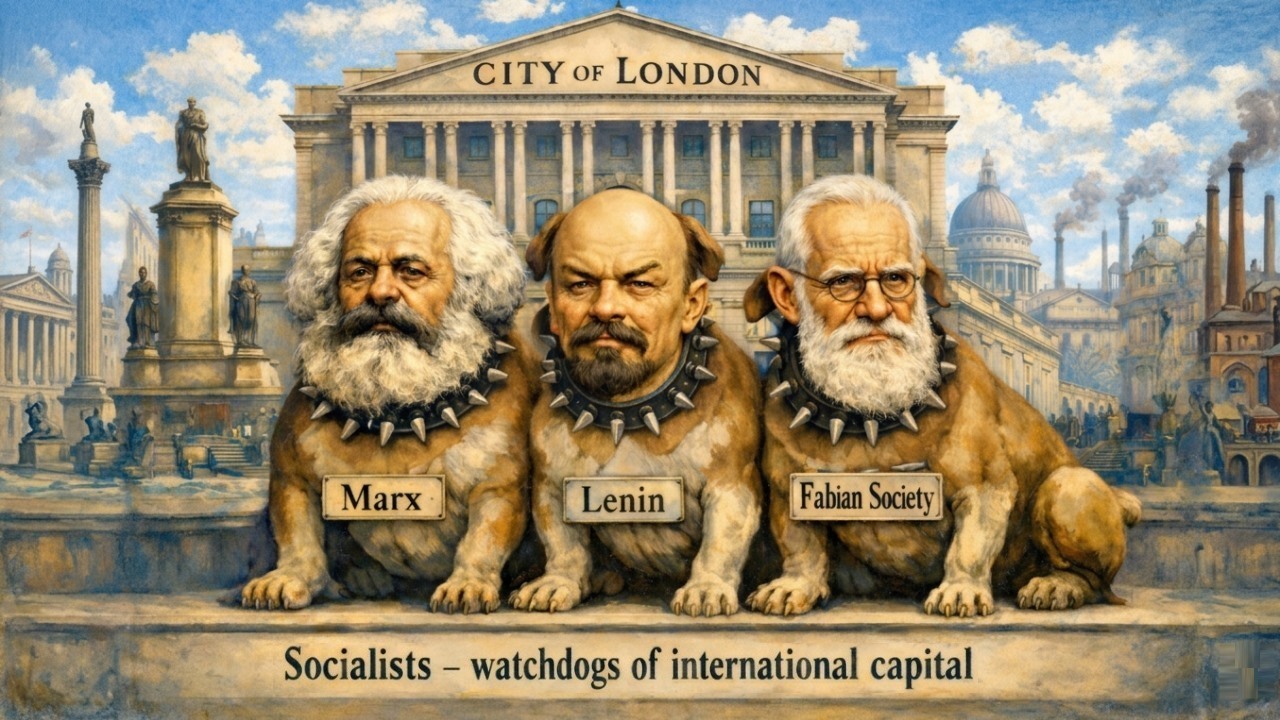
Socialism is believed by some to be a thing of the past and so it ought to be. The only reason why this is not the case is that Socialism is the chosen political creed of the international financial interests which rule the world. This ensures that Socialism is not a thing of the past but of the present and, most likely, of the future.
Understanding Socialism, therefore,
1) enables us to understand recent history,
2) become aware of the present situation
3) and, above all, know what kind of future awaits us.
Socialism's various branches such as Marxism-Leninism (a.k.a. Communism), Social Democracy, Fabianism, etc., have been the driving force behind many negative social, political, economic and cultural changes which have taken place in Europe and the world since the early 1900s. This has to do with the fact that Socialism itself has historical roots in negative developments in the Western world's political systems.
Briefly, these may be described as a shift from monarchy to liberal democracy and from the latter to Socialist dictatorship. In other words, a shift from right to left, where "the Right" stands for the forces of Conservatism and Tradition and "the Left" for the forces of self-serving Change and Revolution (i.e., Destructive Upheaval).
"Right" and "Left"
The political and philosophical terms "right" and "left" originated in the political systems of Western Europe, notably revolutionary France, where conservative supporters of the monarchy in the National Assembly were seated to the right of the presiding official, whereas supporters of the revolution were seated to his left. This practice was historically correct: sitting at the right hand of a ruler had long indicated a position of honour and authority attached to the ruler's representatives.
The Bible describes Christ as sitting at the right hand of God. The word "right" had always been associated with that which is upright, straight, correct, as opposed to that which is not so. Thus, "right" represents the right view and the right conduct which through the experience of generations has become the established order by adhering to which human society prospers and thrives.
Hence
• Greek word "orthos", "right", "correct" and orthodoxia, "right belief';
• Latin ritus, "custom", "ritual";
• German Recht, "law", "right";
• English righteous (right-wise), "morally right", "virtuous", "law-abiding";
• Russian "pravy" (right) has a common root with the words "correct", "fair" and "truth" [* my note].
In contrast to this, we find Latin sinister, "left", from which French and English sinister, "malignant", "wicked", "evil"(cf. Matt. 25:33-41).
The right order of things or Righteousness, that is, truth, order and justice, is not the invention of modem liberal democrats. As far as recorded history goes, righteousness has been associated with the monarchy which has traditionally been entrusted with establishing and upholding righteousness for the good of society. Ancient Egyptian texts state that the deity has set up the king on earth that he may speak justice to the people, defend righteousness and fight evil (Assmann, 1975).
Similar references to kings as upholders of righteousness may be found in the Bible (Ps. 2:6-7; Eze. 45:9) and other religious and philosophical texts. It is not for nothing that the sages of the ancient world, including Plato, advocated a society ruled by wise kings (incidentally, Plato's work on the subject was titled Politeia, "Constitution" or "Just Government", not "Republic" as conveniently mistranslated by Roman republican Cicero and later liberal academics).
Monarchy versus pseudo-republic and pseudo-democracy
While Kingdom and, in particular, "Kingdom of God" is a traditional Christian concept, Republic is not. The concept of King is instantly recognizable as firmly rooted in Christian and even pre-Christian European tradition (note 1, p. 50). By contrast, "president" evokes the image of a person who chairs a business meeting such as (in England) the President of the Board of Trade. As we shall have occasion to see, the business world is precisely where both republican anti-monarchism and Socialism come from.
True, in the Left-dominated intellectual climate of today, the monarchy has come to be associated with ostentation and "undemocratic" practices. But we find that even in republican systems, including in Communist states, rulers reside in palatial homes and live a life of luxury.
As for the claim that monarchy is defined by undemocratic practices, this is based on the erroneous definition of democracy as direct rule by the people. On this definition, we find that no such system exists anywhere in the Western world.
In contrast, if democracy is defined as rule according to the will and in the interests of the people, we find that this definition applies to traditional monarchy (including Plato's "philosopher-kings" who were to rule with the approval and in the interests, of the community; cf. Laws 680e, etc.).
Indeed, to the extent that the monarchy serves to uphold the principles of righteousness for the good of society as indicated above, it is the supreme example of democratic institution. This is confirmed by the fact that the decline of the monarchy has coincided with the decline of traditional society and the concept of righteousness, of what is right and what is wrong, on which true monarchy and true democracy are based.
Three types of transition from monarchy to socialist dictatorship
Although this decline has been hailed by some as "progress", the evidence is that the replacement of the monarchy with republicanism and "liberal democracy" sooner or later culminates in Socialist dictatorship.
This, of course, is not to say that all nations must embrace monarchism. Every nation has the right to choose its own political system - and there is no doubt that republics can function as proper democratic societies in the right circumstances. But republicans should be aware that their system may not ultimately prove to be the better one or deliver the promised boon. Meanwhile, suffice it to note that the transition from monarchy to Socialist dictatorship is a historical fact that no one can deny.
This transition may be classified into three basic types according to the tactics of its architects: Type 1 - overt; Type 2 - imperceptible; and Type 3 - covert.
The most obvious examples of Type 1 are Russia, Germany and Austria which all passed from monarchy to Socialist republic in 1917, 1918 and 1919, respectively.
Type 2 is exemplified by America which developed from royal colony to liberal capitalist and from the latter to quasi-Socialist state under presidents Clinton and Obama. In this type, the transition has been so gradual as to be imperceptible to the general public (though not, of course, to historians and other critical observers). Thus, despite appearances, America is no exception.
The best example for Type 3 is Britain where the monarch has remained head of state, but from 1945 the country has alternately been run by Fabian Socialists (Labour) and "Conservatives" (Tories) increasingly pursuing Fabian Socialist policies.
In all these (and other) examples, the State has acquired more and more powers while democracy, that is, rule according to the will and interests of the people, not to mention rule by the people, has been constantly eroded and suppressed.
What becomes evident is that the loss of the concept of righteousness is directly related to loss of democracy and freedom: the promised all providing Nanny State (in the British sense of welfare state) invariably transforms itself into an all-controlling, repressive Socialist Big Brother State.
Thus, modem history may be defined as a transition from Monarchy to Socialism, from righteousness to unrighteousness and from democracy to dictatorship. According to Karl Marx and likeminded 21st century "progressives", this shift from right to left is the inevitable outcome of the course of history.
The present study refutes this view, showing that this development is in fact the result of systematic machinations on the part of certain self-serving financial and political interests. To claim that it is "inevitable" amounts to believing in the supremacy of selfishness, injustice and evil.
SOCIALISM, KARL MARX AND THE ART OF SUBVERSION
Socialism is falsely projected by its sponsors, followers and supporters as a benign system aiming to raise the living standard of all citizens through equal access to resources, etc. In reality, it is a subversive system aiming to destroy the existing order and seize power as part of its agenda of world domination.
In addition, Socialism has often achieved the opposite of what it had promised, as exemplified by Stalinism in Soviet Russia, Maoism in China, etc., where after decades of State-imposed Socialism the ruling regimes went bankrupt and were forced to import food from capitalist countries like the USA in order to feed their starving populations.
Finally, Socialism has been responsible for some of the most serious crimes in history. Apart from systematic political and religious repression, it has resulted in the death of millions of innocent people.
To be sure, most Socialists are well-meaning, ordinary citizens who are unaware of the true nature and history of the system they support. This is because all the information available to them comes from Socialist-dominated or - influenced sources. However, it is not necessary for all of a system's followers, supporters and sympathizers to be malignant in order for the system itself to be so.
As we shall presently demonstrate, Socialism is not only a malignant system but a fraudulent one. The facts speak for themselves.
Karl Marx
The most influential Socialist ideologist, Karl Marx (1818-1883), was a German-born adventurer with an obsession for secret societies and revolutionary intrigue who sought to subvert for his own ends not only the establishment, but also the revolutionary movements he joined.
It is no coincidence that the French socialist Pierre-Joseph Proudhon called Marx the "tapeworm of socialism" (Haubtmann, vol. 2, p. 200).
Following a failed attempt to foment revolution in Germany, Marx fled to France and then to Belgium where he became the head of the illegal revolutionary organization, the Brussels Communist League. In February 1848, using an inheritance from his father, he funded arms purchases for another (failed) revolution there, for which he was arrested and deported (Jenny Marx in Schiltrumpf, pp. 57-8; Wheen, pp. 126-7).
About this time, Marx came to believe that terror was a necessary part of revolutionary strategy (Galvert, p. 138). Later that year, back in Germany, he wrote: "there exists only one means of shortening, simplifying, and centralizing the death agony of the old order of society and the bloody birth-throes of the new, only one means -Revolutionary Terrorism" ("The Victory of the Counter-Revolution in Vienna", NRZ, 7 Nov. 1848, quoted by Kautsky in Terrorism and Communism, Kerridge's translation, pp. 49-50, see note, pp. 48-9, below).
In February 1849 Marx was put on trial for incitement to armed rebellion, only to be acquitted by a sympathetic jury. As a result, the authorities were left with no choice but to recommend him for deportation as a non-German citizen (he had earlier renounced his citizenship) along with other members of the editorial staff of his revolutionary paper. The police on his heels, Marx fled to Paris and then to London where he remained until his death in 1883.
Unrepentant, Marx continued to believe that Capitalism was doomed and Socialism destined to replace it. In 1850, Marx and his financial sponsor and co-conspirator Friedrich Engels (1820 1895), issued a secret circular letter calling for "decisive, terroristic action against the reaction" in Germany ("Address of the Central Committee to the Communist League", March 1850, MECW, vol. 10, p. 277; Marxists Internet Archive (MIA), www.marxists.org).
The activities of the Communist League, founded by Marx and Engels in London in 1847, led to the trial of its members in Cologne and the subsequent dissolution of the organization in 1852.
In 1864, Marx took part in the founding of the London International Workingmen's Association, known as the First International (IWMA), and soon became its leader, being elected to the General Council (IWMA, the "First International").
Socialist revolution as a reign of terror
Between 18 March and 28 May 1871, a group of Socialist revolutionaries, some of whom were followers of Marx and members of his IWMA, seized the French capital and established an authoritarian regime which committed various atrocities such as executing scores of hostages, including the Archbishop of Paris.
This regime came to be known as the "Paris Commune" and it became a model for Marxist revolutionary ideology (Marx, The Civil War in France, MECW, vol. 22, p. 540; cf. Postscript by Engels, 18 Mar. 1891).
The exact role played by Marx and his collaborators in the uprising is not entirely clear. However, in April 1871, Marx associated himself with the Paris Commune by writing that it was the "most glorious deed" of their Party since the June 1848 insurrection in Paris (Letter to Dr. Kugelmann, 12-17 Apr. 1871, MECW, vol. 44, p. 131, emphasis added).
He later declared that the Commune will be forever celebrated as the glorious harbinger of a new society ("Third Address to the General Council of the International", 30 May 1971, The Civil War in France, MECW, vol. 22, p. 230).
Marx's views drew criticism even from his own organization (IWMA) and he became known as "the Red Terror Doctor" (Letter to F. A. Sorge, 27 Sept. 1877, MECW, vol. 45, pp. 277-8; Berlin, pp. 1889).
On his part, Engels in 1872 defined revolution as a reign of terror, stating that it was "the act whereby one part of the population imposes its will upon the other part by means of rifles, bayonets and cannon" and that the victorious party had to maintain this rule by means of "the terror which its arms inspire in the reactionaries".
While approving of the Paris Commune, Engels criticized it for not using terror freely enough ("On Authority", published Dec. 1874, MIA).
Apologists for Marxism typically attempt to shift the goalposts by claiming, for example, that since the Commune was controlled by Marx and Engels' Blanquist and Proudhonist rivals, "our Party" could only have been meant in a broad sense (Walicki, p. 326). But this is beside the point.
The real point at issue, which must be beyond dispute, is that Marx and Engels described the Commune in terms indicative of their approval and admiration. Whether it was their party in a narrower sense or not, it was a movement to which they admittedly belonged and whose actions they openly endorsed.
Towards the end of his life, having failed to start a successful Socialist revolution in Western Europe, Marx turned his attention to Russia (even learning the language), declaring that this time the revolution will begin in the East (Letter to F. A. Sorge).
Marxism was later introduced into Russia by Marx's disciples Georgii Plekhanov, Vladimir Lenin and Leon Trotsky. Lenin and his Bolshevik gang readily embraced terrorism both while in the underground and after they seized power in the Communist Revolution of October 1917 (Law, pp. 76-7).
Bloodthirsty followers of Marx
Following in the footsteps of Marx and Engels, Lenin berated the Paris Commune for "excessive magnanimity", quoted Marx and Engels to justify his own support for dictatorship and revolutionary terrorism (The Proletarian Revolution and the Renegade Kautsky, MIA; cf. Walicki, pp. 326 ff.); created a secret police (CHEKA) as an instrument of state terror (ET, p. 72); and started the infamous campaign known as the "Red Terror" (Pipes, 1996, pp. 55-6), in which he ordered the internment of farmers, priests and "other doubtful elements" in concentration camps and public executions (Telegram to the Penza authorities, 9 Aug. 1918, Legget, p. 179; Telegram to the Penza authorities, 11 Aug. 1918, Pipes 1996, p. 50; Courtois, p. 73).
As noted by George Legget, political concentration camps ("gulags") used to isolate and suppress political opponents originated in Soviet Russia (Legget, p. 179).
Similarly, Lenin's deputy Trotsky wrote Terrorism and Communism (1920), in which he openly boasted that his party were never concerned with the "prattle about the 'sacredness of human life'"; that the revolutionary class should attain its ends by all methods at its disposal, including terrorism; and that to reject terror was to reject Socialism.
Another leading figure in Lenin's Socialist regime was Nikolai Bukharin who claimed that terror was a permanent principle of socialist organization (Kolakowski, p. 811). In his turn, CHEKA head Felix Dzerzhinsky said in an interview published in the official Novaia Zhizn (14 July 1918), "We stand for organized terror -this should be frankly admitted."
Meanwhile, China's Moscow-backed Mao Zedong declared in 1927 that it was necessary to bring about a reign of terror all over the country (Schram, vol. 2, p. 435; Chang & Halliday, p. 43).
Marxist-Leninist-Maoist terrorism later spawned a wide range of terrorist movements from the German Baader Meinhof Gang which was controlled by East Germany's Marxist intelligence chief Markus Wolf -and the Italian Red Brigades to the Peruvian Shining Path and many others.
Marxist Irish Republican Army
Even movements generally deemed "nationalist" have frequently been either initiated or subsequently taken over, by Marxists and other Socialists. Irish Nationalism, which was diverted for Socialist purposes at an early stage, is a case in point. Socialist Republican elements like Irish Republican Army (IRA) leader James Connolly had already infiltrated the movement in the early 1900s (English, pp. 100 ff.).
In the 1930s, the IRA which had emerged during the 1916 Easter Uprising, embraced Socialism (Law, p. 233), while carefully preserving the appearance of a nationalist movement.
In the 1970s, while denying being Marxist or Communist, the Provisional IRA (PIRA) committed itself to a Socialist Ireland. PIRA' s political wing, the Provisional Sinn Fein, described itself as a movement "totally committed to revolution right across the board from top to bottom" (Janke, pp. 98, 103).
Former PIRA leader Gerry Adams proudly proclaimed that the Republicans' aim was to establish a Socialist State ("Northern Ireland: It is Clearly a War Situation", Time, 19 Nov. 1979; cf. "Belfast Militant Is Elected Head Of Sinn Fein", New York Times, 13 Nov. 1983).
It should be noted that the expression "top to bottom" reveals an important feature of all socialist movements: their undemocratic character and their desire to impose their will on the unsuspecting masses.
The Irish, Basque and Kurdish cases are just some of the many examples of national independence movements being cynically hijacked and converted into instruments of international Socialism whose ultimate aim is to abolish the nation-state. This, of course, is not unconnected with the fact that the Right has all but given up on national interests and has surrendered the initiative to the Left.
The predictable result is that instead of having sovereign nations, mankind is inexorably moving towards a Socialist world state.
SOCIALISM AND DICTATORSHIP
Dictator Marx
By most accounts, Marx was an overbearing and authoritarian character who did not tolerate opposition or dissent in any form. According to police reports, his dominant characteristic was a boundless ambition and desire for domination (Lovell, p. 25).
Michael Bakunin, Marx's colleague and rival in the IWMA, described him as a "fanatical authoritarian" who "will not stop at the basest intrigue if, in his opinion, it will serve to increase his position, his influence and his power" (Berlin, p. 80). Even Marx's employer, Gustav von Mevissen, referred to him as "domineering" (Wheen, p. 38).
His strategy was simple: his behaviour meant that his prospective collaborators either turned away in disgust or allowed themselves to succumb to his bullying. As there were always some who would choose the latter, this ensured him a small but loyal following.
Marx's dictatorial ambitions were matched only by his violent ideology based on "class struggle", "revolution" and, in particular, the "dictatorship of the proletariat". He interpreted Capitalism as the "dictatorship" of the middle class (which he derogatorily called "bourgeoisie") over the working class (which he called "proletariat").
His aim was to reverse the roles of the two classes through armed revolution and establish a dictatorship of the working class over all other classes. Indeed, Marx claimed that the "dictatorship of the proletariat" was the inevitable result of class struggle and revolution (Letter to J. Weydemeyer, 5 March 1852, MECW, vol. 39, pp. 62, 65).
Allegedly, this dictatorship would lead to a new era of Communism -a utopian "classless society" based on common ownership.
Marxist apologists falsely claim that Marx never endorsed dictatorship by any individual and that he did not promote organizations "in which his will would be primary" (Lovell, pp. 25-6).
Marx may not have overtly endorsed dictatorship by any individual, but he was certainly involved in the creation of the Communist Correspondence Committee, the Communist League, the Brussels German Workers' Association, the Brussels Democratic Association and the London-based First International, all of which aimed to place themselves at the head of the revolutionary movement and in all of which he strove to acquire a leading position for himself.
It is evident from Marx's own statements that he judged the merit of all Socialist organizations solely by the degree to which he could control them (Berlin, p. 193).
As evident from the Communist Manifesto itself, Marx intended the Communist Party (of which he was a leading figure) to take the lead in a revolution (cf. Priestland, p. 40). Clearly, a successful revolution carried out by any of these organizations would have resulted in a dictatorship run by such an organization, e.g., the First International (IWMA), over whose General Council Marx admittedly had (in his own words) "decisive intellectual influence" (Lovell, p. 29).
In fact, Marx did not merely "influence" the IWMA but, as its general secretary, was its official leader. This would have placed Marx in a position very close to that of a dictator.
Engels himself was no less dictatorially-minded (Berlin, p. 193). While Marx preferred to scheme from behind the scenes, at the most financing the purchase of arms for Socialist revolutionaries in Brussels or calling for "class war against the bourgeoisie" in Vienna (Rapport, pp. 230-1), Engels - who went by the sobriquet the "General" - took active part in armed insurrection with the clear intention of converting Germany's Democratic-Constitutional revolution into a Socialist-Republican coup and imposing his own minority (or personal) agenda (Rapport, p. 342).
There can be little doubt that Marx and Engels' compulsive rebelliousness against established authority coupled with the drive to impose their own authority on the world were rooted in their hatred of their fathers as well as their desire to eliminate and replace them, which they consciously or subconsciously projected on others. In Marx's case, this was considerably aggravated by violent moods and mental imbalance (Shuster, 2008).
The editor and columnist Stuart Jeffries of Britain's left-wing Guardian believes that there is no direct link between the Communist Manifesto and the gulags (Jeffries, 2012). It may be the case that neither Marx nor Engels can be held legally responsible for the crimes of later Socialist regimes, given that they died long before those regimes were established. But their advocacy of revolution and repression of opposition to it makes them intellectually and, above all, morally responsible. Their teachings certainly were a causal factor in the actions of their disciples (Lovell, pp. 15, 192).
Like all political demagogues, Marx advocated different policies at different times, sometimes preaching an evolutionary Socialism, based on the theory that Capitalism would evolve into Socialism over time and sometimes a revolutionary Socialism, based on conspiracy and terrorism (Bernstein, p. 152; Kolakowski, p. 437). This made it inevitable that some among his disciples (the Social Democrats) would embrace one policy and others (the Marxist-Leninists) the other.
As evident from Marx's 1850 Address to the Communist League, he believed in revolution by a small, self-appointed clique who would seize power and hold on to it as the executive committee of the masses in whose name they claimed to act. This doctrine was taken up by Alexander Helfand (alias Parvus) and put into practice by Lenin and Trotsky in 1917 (Berlin, p. 138). The concepts of "class struggle", "revolution" and "dictatorship of the proletariat" popularized by Marx and Engels became central to later Marxist thinking.
Marxism is always realized as a dictatorship of the party elite
Lenin went to great lengths in using Marx and Engels' teachings to extract support for his own theories of dictatorship (Walicki, Lovell). He insisted that Socialist dictatorship was not bound even by its own laws, writing that the secret police (CHEKA, forerunner of the KGB) should instruct the courts on what sentences should be passed (Lovell, pp. 174-5).
Trying people in accordance with Party guidelines later became established routine in the Soviet Union (Radzinsky, p. 251) and was faithfully emulated by its Socialist satellites from China to Eastern Europe. This, of course, was based on Marx's dismissive comments on the rule oflaw as "obsolete verbal rubbish". In Marx's view, the law in Socialist society was not to be above political considerations ("Critique of the Gotha Programme", 1875, MESW, vol. 3, pp. 1330; M/A).
Lenin taught that Socialist revolutionaries must be "merciless" and "ruthless" (Walicki, p. 271). As he put it, the proletarian dictatorship had to be "cruel, stem, bloody and painful" (LCW, vol. 29, p. 355). As the black leather-clad CHEKA (originally "The All-Russian Extraordinary Commission for Combating CounterRevolution and Sabotage") was the official instrument of State terror established to crush all opposition (ET, p. 72), it requires no great mental effort to grasp what Socialist "dictatorship of the proletariat" meant in practice, regardless of what it might have meant in theory.
But it is not the case that Marxist doctrines were merely employed by power-obsessed fanatics like Lenin and Stalin to legitimize their totalitarian practices. As pointed out by R. G. Wesson and others, authoritarianism is inherent in Marxism (Lovell, p. 11). Among the reasons why this is so is the central Marxist concept of "classless society" itself.
The absurd socio-economic theories of Marxism
Classlessness presupposes a society in which all citizens have the same occupation and the same income. It implies that all are portioned out an equal share regardless of the intelligence, skills, physical effort or time they put into their work. Not only is such an arrangement morally wrong, leading to the kind of morally bankrupt society as seen in the former Communist Bloc, but it is practically impossible. It can only be attempted (never accomplished) through coercion.
Marx himself admits that due to the inherent inequality of individuals (one being stronger or weaker than another, etc.) even a system where each receives an equal quantity of products in return for an equal quantity of labour leads to inequality, resulting in a situation in which "one will in fact receive more than another, one will be richer than another, and so on". In fact, Marx completely dismisses ideas like "equal right" and "fair distribution" as "obsolete verbal rubbish" - just as he dismisses the rule of law. Having dodged the question, he characteristically "settles" the matter by claiming that in a "higher phase of Communism" the rule will be "from each according to his ability, to each according to his needs!" ("Critique of the Gotha Programme", 1875, MESW, vol. 3, pp. 13-30, Marx's exclamation mark).
Like all other key questions, the issue as to who will decide what each person's ability and needs are, is conveniently left unanswered by "scientific" Marxism and for very obvious reasons, too: it would be the Communist Party, Marx's own organization, who will have control over these and other matters.
As the Communist Manifesto declares, all capital and means of production were to be concentrated in the hands of the State. As representative and executive power of the State, the Communist Party (Marx and Engels' own clique), would have been the dispensing authority. As is well known, this was the case of Soviet Russia and other Communist regimes in the 2Qth century.
Yet to admit this much would have amounted to admitting that Socialism is not only a dictatorial but a totalitarian system. Hence Lenin (paraphrasing Marx) dodges the question by claiming that only someone "with the hard-heartedness of a Shylock" would stoop so low as to calculate the exact quantities given or received.
Incredibly, Lenin insists that such a "narrow horizon" will be left behind and that there will be "no need" for such calculations as each will "take freely according to his needs". Even more incredibly, Lenin in the same breath says that until the arrival of the "higher phase" of Communism, the Socialist State will demand the strictest control of the quantities of labour and consumption.
In a fit of Orwellian doublethink or schizophrenia by now typical of Marxist thinkers, what had been dismissed only a few sentences before as "the hard-heartedness of a Shylock" was now admitted to be official policy of the Socialist State! He concludes that asking such questions is a display of "bourgeois stupidity" (The State and Revolution, 1917, LCW, vol. 25; MIA).
If in 1917, the first year of the Revolution, the intrepid enquirer was called a "bourgeois idiot", after 1918 and the creation of the secret police (CHEKA), expressing doubts about the infallible wisdom of the Party meant being branded "bourgeois enemy", "class enemy", "enemy of the people" or "enemy of the Revolution" and being sent to the concentration camps or shot (Applebaum, p. 111). This may have silenced opposition, but it changed nothing about the absurdity of Marxist teachings.
Equally absurd was Marx's concept of "market-less society" which, again, can only be attempted by force. As the Soviets themselves came to realize, no advanced society can exist without exchange of goods. The notion of producing goods and then freely distributing them or letting everybody help themselves "according to their needs" is a fantasy bordering on the pathological that could only have sprung from the overexerted minds of amateur philosophers like Marx and third-rate lawyers like Lenin.
The dictatorship of the proletariat is a cunning cover for the dictatorship of the party elite
The same applies to Marx's doctrine of "proletarian dictatorship". It is obvious that a whole class cannot be involved in government. Governing would have to be entrusted to a select few and this would result in the rule of a handful over the majority.
If it is claimed that such a system would nevertheless be democratic because it serves the interests of the majority, the answer is that the majority at the time of Marx consisted in fact of farmers, artisans, traders, etc., not "proletarians", i.e., urban (industrial) workers. This was especially true of Russia where Marx wanted to export his system in his last living years. Lenin himself admitted that Communist Russia in 1920 was not a workers' state but a workers' and peasants' state "with a bureaucratic twist to it" ("The Trade Unions, The Present Situation and Trotsky's Mistakes", 30 Dec. 1920, LCW, vol. 32, p. 24).
In fact, Russia never became a "workers' state" even after eight decades of Socialism. The same is true of China which remains a technocratic dictatorship over the proletariat where the farming majority is brutally suppressed.
Even if we allow for a society where the majority actually are urban workers, the claim that the governing elite represents the workers' interests cannot be tested in a system which admits of no other representatives. Moreover, those chosen to govern would cease to be workers by virtue of their new, non-proletarian occupation, and would become a new class of governors. Far from being classless, such a system would create a new class as in fact it did in Russia and other Communist states.
Again, Lenin's standard reply to those who questioned Socialist dictatorship was to brand them as "fools", "idiots" and "politically ignorant" persons who were not to be allowed anywhere near a meeting ("Achievements and Difficulties of the Soviet Government", March-April 1919, LCW, vol. 29, pp. 71-2).
The fact is that, like other Marxist absurdities such as "classless", "market-less", "stateless" society, the "dictatorship of the proletariat" is a practical impossibility which can only be attempted through coercion by a fanatical and self-serving clique who knows itself to be in the minority (and in the wrong) and has no other means of imposing its agenda but lies and brute force.
It demonstrates that Marxism is as authoritarian and dictatorial as its inventor and it exposes Socialism's true aim, namely to create a new governing class and take over political power on behalf of a self-serving elite.