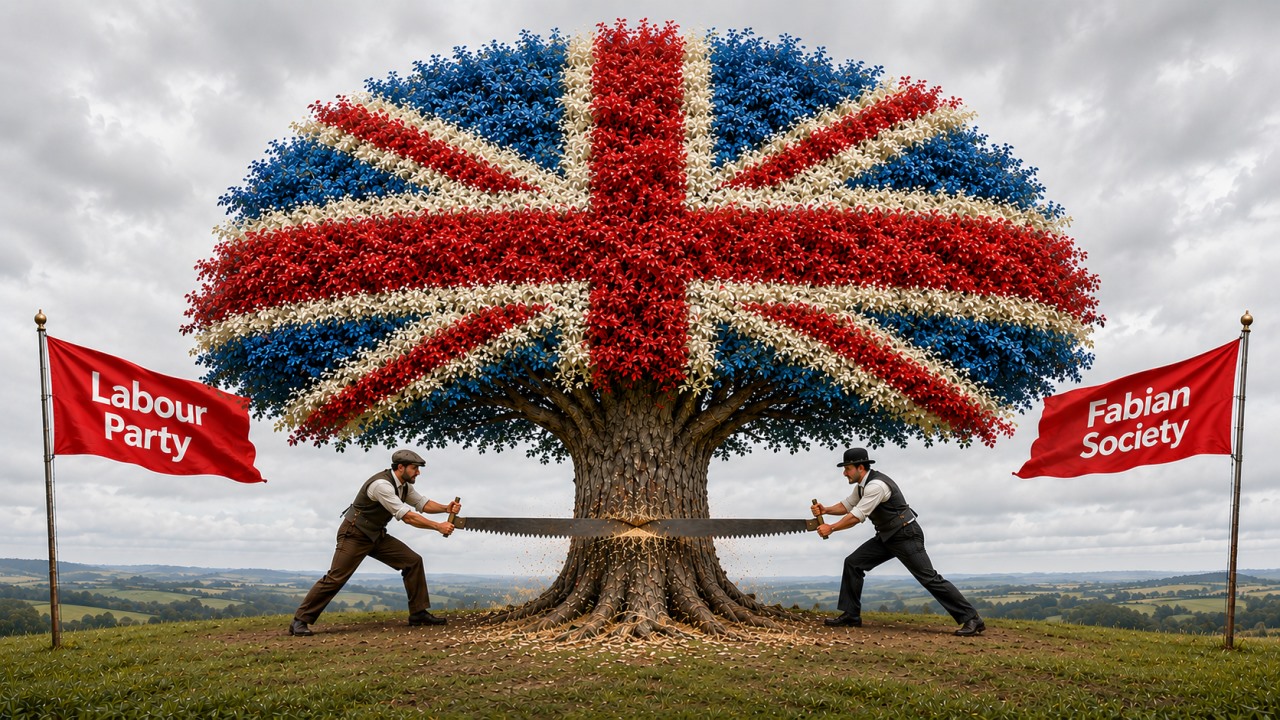
The Labour Party is the largest, most powerful and most dangerous group to have infiltrated British society and taken over political power in modern history. Here is why everything about the Labour Party is deceptive, anti-democratic and anti-British.
The Labour Party has its roots in Fabian Socialism, a subversive ideology inspired by Marxism which aims to create a totalitarian New World Order - Labour leaders have openly declared that "the Labour Party will not abandon, now or ever, the vision of a New World Order" (Labour Party Annual Conference Report, 1939) - while claiming to promote "social justice", "welfare", "prosperity", etc. [*]
[*] Му note.
The Fabian Society's plan to create a totalitarian New World Order was exposed by George Orwell in his novel Nineteen Eighty-Four. Written with the Fabian Society's 1OOth anniversary in mind, this was one of the few works by an ex-Fabian criticizing Fabian Socialism (referred to as "English Socialism" or "lngSoc" in the book).
Orwell's book betrays an intimate knowledge of the Fabian movement, its leadership, methods and aims, enabling it to make uncannily accurate predictions about a future Fabian-controlled society. (See Chapter 2. The Fabian Conspiracy.)
For Orwell's membership in Fabian organizations, see Rose Martin, "Fabian Freeway: High Road to Socialism in the U.S.A.", p. 466, Chicago, IL, 1966.
End of my note.
The Labour Party was created for the purpose of controlling the working classes by the Fabian Society, a semi-secret private organization with links to financial and industrial interests, whose leaders covertly advocated dictatorship while ostensibly promoting "democracy" and continues to be controlled by the Fabian Society. (See chapter 2, "The Fabian Conspiracy".)
The identity of the Labour hierarchy with the Fabian Society (FS) is evident from the fact that FS membership increases dramatically,
• from only 3 per cent in the general Labour membership
• to about 50 per cent among Labour MPs,
• rising to nearly 100 per cent among Labour Leaders and Prime Ministers.
Indeed, the FS:
• trains Young Fabians (the Societys under-31s section) to become Labour MPs (about half of whom have been FS members from 1945),
• provides leaders and PMs to the party (all or almost all Labour Leaders, Deputy Leaders and Prime Ministers have been Fabian Society members from inception),
• organizes its conferences, writes its programmes and manifestos and leads its election campaigns.
The Fabian Society has also been able to nominate candidates for the Labour Party leadership and influence their election through the partys electoral college which included Fabian MPs and party members.
In 1994, the Fabian Society (FS) and, in particular, Young Fabians activists, backed Tony Blair, a long-time FS member (who had recently joined the World Economic Forums "Global Leaders of Tomorrow"), in his bid for the Labour Party leadership.
The Fabian Society also devised the "New Labour" brand which was central to Labours election campaign under Blair and published the latters pamphlet "The Third Way" after the election.
In the 2010 leadership contest, all key candidates (Ed Miliband, David Miliband, Ed Balls and Andy Burnham) were Fabian Society (FS) members, thus ensuring that a Fabian backed by the Society (Ed Miliband) became leader.
In addition, the party is kept on a Fabian course through leading Fabians like:
• FS general secretary Dianne Hayter sitting on its executive and policy forum;
• "special advisers" like Michael Jacobs (FS general secretary) and Ed Balls (FS chairman) who dominated the Treasurys Council of Economic Advisers under the last Labour regime;
In line with its Fabian agenda, Labour has been responsible for introducing policies like mass immigration and multiculturalism, deliberately designed to destroy traditional British society and reconstruct it in line with its internationalist schemes.
In particular, Labours policy of state-sponsored mass immigration has resulted in lower wages and higher living costs, exposing it as a fraudulent organization working against the interests of the British working classes whom it falsely claims to represent.
HISTORY OF THE LABOUR PARTY
In the late 1880s, the Fabian Society together with other Marxistinspired organizations like the Social Democratic Federation (SDF, founded in 1881), began to influence the labour movement and campaign for the formation of a separate labour party, creating the Independent Labour Party (ILP) in 1893.
In 1903, the LRCs Fabian leadership made a secret pact with the Liberal Party against the Conservatives. This enabled it to win 29 seats in the 1906 general elections, after which it renamed its organization The Labour Party.
True to its Fabian strategy, the Labour Party soon began to displace its former Liberal allies and by 1922 it became one of the two major political parties. In 1924 and 1929 it formed a minority government and in 1945 it formed its first majority government under Fabian Prime Minister Clement Attlee.
Already in 1905, the Labour Representation Committee had declared as its ultimate object the overthrow of Capitalism and "the institution of a system of public ownership of all means of production, distribution and exchange". In the same vein, the Labour Party constitution adopted in 1918, written by Fabian leader Sidney Webb, aimed to establish state ownership of the means of production as well as state (i.e., elite) control of all industries and services (Pugh, p. 138).
Following the 1917 Communist Revolution in Russia, the Labour Party was quiet about the new regime for fear of being associated with revolutionary violence. However, by the early 1930s, the rise of nationalism and anti-Communism in Europe forced Labour leaders to show their true colours:
• In 1931, Sidney Webb declared his belief that the Soviet Union was a model Fabian State (Cole, p. 255).
• In 1932, Webb and his wife Beatrice visited the Soviet Union and published a massive study eulogizing Stalins Communist regime as a "new civilization" to be emulated by the world (Soviet Communism: A New Civilization, 1935).
• Similarly, Leonard Woolf, secretary of the Labour Partys Imperial and International Advisory Committees, described the Soviet Union as "the greatest civilization in human history" (Callaghan, p. 121).
The creation of a Nanny state
During World War II, Labour MPs who had joined Winston Churchills coalition government began to campaign for Socialist policies like nationalization, "social welfare" based on increased taxation and public spending and, in particular, cooperation with the Soviet Union as "the principal rallying point for the forces of Socialism throughout the world" (Callaghan, p. 156).
On its election to office in 1945, the Labour government under Fabian PM Clement Attlee introduced the Beveridge Plan which created the "cradle to grave" welfare or Nanny state in order to sugarcoat Socialism and deflect attention from its real agenda.
This agenda was the nationalization of industries and services, i.e., transfer of control to a self-appointed clique, in imitation of the Soviet model and the dismantling of the British Empire in preparation for the establishment of a Socialist world government.
(Despite his outward appearance, William Beveridge, judging by his book Power and Influence and other evidence, was as self-promoting and power-obsessed as the Fabian Society who co-authored his Plan.)
Role in the creation of the UN and NATO
Among other Socialist projects, Labour was instrumental in the creation of the United Nations (UN) which was run by pro-Soviet Socialists advised by Soviet Communist officials (Griffin, pp. 110, 114, 117-8) and the North Atlantic Treaty Organization (NATO).
Ostensibly meant to contain the expansion of Soviet and Chinese Communism, NATO was in fact used by the Attlee government as a smokescreen to make deals with the Communist regimes and promote world Socialism.
In a 1952 essay with an introduction by Attlee, leading Labourite (later Labour Party Chairman) and Fabian Richard Crossman wrote:
"A victory for either side would be a defeat for socialism. We are members of the Atlantic Alliance (NATO); but this does not mean that we are enemies of every Communist revolution" (Griffin, p. 173).
The creation of the Socialist International
At the same time, the Labour Party (and the Fabian masterminds behind it) was responsible for re-establishing European Socialism by reorganizing Socialist parties in Allied-occupied Germany and elsewhere and by setting up the Socialist International (SI, headquartered in London) as an instrument for coordinating, controlling and promoting International Socialism with a view to establishing world government.
Well into the 1960s, the Labour Party (under Fabian Harold Wilson) promoted the idea of the Soviet Union - which included concentration camps and forced labour for political prisoners - as a superior social and economic model to be emulated by Britain (Callaghan, p. 156).
While its rhetoric has become more guarded and sophisticated, the Labour Partys policies continue to be dictated by the old Socialist ideology of its Fabian founders (represented by Fabians like Ed Miliband) which explains the catastrophic results Labour governments have had on Britain and the world.
LABOURS UTTER BETRAYAL OF THE COUNTRY
The areas on which the Labour Party has met strong - and fully justified - criticism from both rival parties (the Conservatives and the Liberal Democrats) and the general public include: the economy, education, social breakdown, extremism, crime, immigration, multiculturalism and Islamization.
The Economy under Labour
Labours economic policies are devised by its Fabian masterminds and promoted through Fabian outfits like the:
They were already exposed as bogus in the 1950s, following its introduction of Marxist-inspired measures such as the nationalization of coal, iron and steel industries.
The policies imposed by Tony Blair and Gordon Brown following the Labour take-over of 1997 resulted in the longest and deepest recession since World War II, creating an unprecedented budget deficit of 90 billion pounds sterling in 2008/09.
The apparent economic "boom" of the first years of Labour rule turned out to be a typical Labour con based on a corrupt credit system. As conceded by the Guardian, not only is the deterioration of the public finances unprecedented, but it is due to the credit crunch which began in 2007 ("UK budget deficit hits record 90bn pounds sterling", 22 Apr. 2009).
The Labour-created economic disaster left three million people unemployed.
In the face of the facts Labour leader Ed Miliband was forced to declare that his party "take responsibility for the financial crisis that took place in 2007-2008" ("Miliband: We Take Responsibility for Crash", Sky News, 28 Sept. 2011; p. 507).
The 2010 British Social Attitudes Survey, conducted by the National Centre for Social Research, has shown that the majority of British people reject Labour policies like increased taxation, public services spending and, in particular, the welfare system which is seen as lending itself to abuse and preventing people from standing on their own feet ("Labour has pushed public opinion to the right, national survey suggests", The Times, 26 Jan. 2010).
Labours Keynesian (i.e., Fabian) policy of perpetual deficit spending also renders the economy increasingly dependent on international finance, strengthening the hand of the corporate elites whose interests the Labour party covertly represents.
The Education System under Labour
The education system in Britain has been under Labour control since 1934 when the Labour Party took control of the London County Council - responsible for elementary and secondary schools - and similar bodies across the country. It had earlier seized control in universities and other institutions, notably, Fabian-created ones from LSE to Imperial College London.
Labours education policies have been severely criticized by leading figures from politicians to business and industry leaders. A poll by the charity Business in the Community has found that many young people are unemployable, lacking skills from reading and writing to punctuality, presentation and communication ("School leavers are not fit for work, says M&S chief, Daily Mail, 24 Nov. 2009). Office for National Statistics figures show that there were 100,000 unemployed graduates under 25 in 2009.
The fact that the Labour regime found it necessary to import millions of skilled workers from countries like Pakistan speaks for itself. It shows that in spite of the vast amounts of tax-payers money invested in it, Britains education system is worse than that of failed Third World states!
The breakdown of British society under Labour
Already in the 1950s and 60s, British peoples traditional strong sense of family life and attachment to Christian values were labelled "unadmirable" and "undesirable" by Labours Fabian ideologists (Wollheim, p. 12). This was no accident. Karl Marx himself in his Communist Manifesto had boasted that Communists wanted to abolish the family.
Like Marx, early Labour leaders such as Bernard Shaw were outspoken opponents of the family. As admitted by Tony Blair, "the old left tended to ignore the importance of the family" (Rentoul, p. 201). Unfortunately for the long-suffering British people, the "new" Left changed its policies about as much as leopards change their spots.
Whether "old" or "new", Labour policy has been to ignore the importance of marriage in the development and progress of children, allegedly so as not to appear "discriminatory or judgemental" towards unmarried and single parents.
The direct result of this has been that in 2009 married couples became a minority in Britain for the first time in history and this in turn has led to a rise in broken homes and the anti-social and criminal behaviour that comes with it.
Labours Fabian Schools Secretary, Ed Balls, belatedly admitted that this policy was a mistake ("Labour does U-turn on love and marriage", The Sunday Times, 27 Dec. 2009).
The overall result of Labour policies has been that the overwhelming majority of Britons (70%) now believe that British society is broken ("Were living in broken Britain, say most voters", The Times, 9 Feb. 2010).
The rising crime wave under Labour
Although Labour came to power in 1997 with the pledge of being "tough on crime, tough on the causes of crime", the truth is that with the rise of broken homes resulting from Labours anti-family policies, there has been a rise in anti-social and criminal behaviour among young people.
In 2000 there was a significant rise in violent crime and this trend continued unchanged under Labour rule ("Big rise in violent crime", BBC News, 18 Jul. 2000; "How the police missed the violence", BBC News, 23 Oct. 2008).
Gavin Lockhart, head of Policy Exchanges crime and justice unit has said: "After a decade of unprecedented spending on policing, courts and prisons, England and Wales have a recorded crime rate twice that of the European average" ("UK failing on causes of crime", BBC News, 11 May 2009).
In particular, religion-motivated extremism became a new cause of crime under Labour.
Immigration under Labour
In 1948, Labour Prime Minister Clement Attlee passed the British Nationality Act allowing all inhabitants of the British Empire to enter, live and work in the UK without restriction. Although public opinion forced it to introduce some restrictions on immigration, the Labour Partys long-term policy has been to allow more and more immigrants into Britain under various false pretences like the "need of skilled workers", etc.
In 1997-2010, Labours Blair-Brown regime imposed an official, deliberate and systematic policy of mass immigration, while blatantly lying about the true extent of immigration ("Labour lied to public about immigration, says Ed Milibands aide Lord Glasman", Daily Telegraph, 17 Apr. 2011).
Labours policy of mass immigration, that is, deliberate and systematic import of cheap labour from abroad, resulted in wages being kept artificially down and, in particular, in the replacement of Britains indigenous population with immigrants, clearly exposing Labourism - a system ostensibly representing the British working class - as a fraudulent, indeed criminal, system.
Multiculturalism under Labour
In 1966, Labour Home Secretary and future President of the European Commission, Roy Jenkins, initiated a shift in government policy from assimilation of immigrants to statepromoted "integration accompanied by cultural diversity" or multiculturalism (Patterson, p. 113). The dishonest intent of Jenkins actions is evident from the fact that he deliberately waited until after the elections (in which Labour won an increased majority) to start promoting this change of policy (Banton, p. 71).
Since then, the policy of the Labour Party has been to transform Britain into a multicultural society. This is supposed to "enrich" British culture and make British society "better", "more competitive" and "more successful".
The 1997-2010 Labour regimes relaxation of immigration controls was a deliberate plan "to open up the UK to mass migration" in order to make it "more multicultural" ("Labour wanted mass immigration to make UK more multicultural, says former adviser", Daily Telegraph, 23 Oct. 2009).
As in the case of mass immigration, multiculturalism has been made a virtual taboo subject. The British people have been given absolutely no say on the matter and all objective and critical discussion has been systematically suppressed and stifled.
"Anti-racism" under Labour
Labours immigration policies led to the transformation of Britain into a multiracial society. The resulting inter-racial tensions were then used by Labour politicians to win the votes of immigrant communities and muster support for its anti-majority policies.
"Anti-racism" has become Labours tool of choice for suppressing the rights of the indigenous population (Lewis, pp. 137 ff.), in effect becoming a new form of racism directed against the white majority.
The suppression of Christianity under Labour
Christianity has always been a key target for Socialist subversion and the Labour Party had sought to infiltrate, subvert and distort Christian religion from the time of Keir Hardie and other early Labour leaders. Labours subsequent aggressive promotion of atheism (disguised as "secularism") as well as non-Christian cultures and religions, notably Islam, inevitably led to the growing suppression of Christianity.
The Labour regime of 1997-2010, in particular, was defined by a marked rise in anti-Christian incidents including the banning of carol singing and Nativity plays in schools by left-wing local councils and headteachers (Henry & Miller, 2007).
In light of the facts, Church leaders were forced to admit that Christians have become "too soft" and allow others to "walk over them" (Whitehead, 2010). To this deplorable situation the Left-dominated Church itself has contributed in no small measure.For, while Muslim preachers tell their congregations to stand up and fight for their faith, Christians have been told, for decades, to be "tolerant", "inclusive" and to put others first.
Labours promotion of Islam and the spread of Islamic Extremism
The idea that gained ground under Labour was that Islamic extremism could be combated by allowing moderate Muslims to play a greater role in local governments, police and armed forces and other key sections of British society.
In reality, the Labour policies of:
• appointing Muslims to key positions in the Labour Party, Ministry of Justice, Home Office (responsible for immigration and asylum) and Social Services;
• uncontrolled and unlimited immigration from Islamic countries, especially Pakistan;
• shambolic student visa system;
• mandatory multiculturalism;
• systematic sponsorship of Islamic schools, cultural centres, charities and mosques, etc.,
enabled Islamic extremist organizations to infiltrate all sections of British society and obtain support, funds and recruits for their anti-British activities.
In 1998, under Tony Blairs newly elected "New Labour" regime, Nazir Ahmed who was born in Pakistan-occupied Kashmir, became Britains first Muslim life peer.
In 2000, Tony Blair infamously stated in an interview with Muslim News: "There is a lot of misunderstanding about Islam. It is a deeply reflective, peaceful and very beautiful religious faith and I think it would be hugely helpful if people from other religious faiths knew more about it" (Muslim News, March 2000).
As noted earlier, in August 2006, Tony Blair praised the Koran as "progressive" and Muslim-occupied countries as "the standardbearers of tolerance" (Speech to the World Affairs Council in Los Angeles, 1 Aug. 2006; news.bbc.co.uk).
The belief in a religions apparent ability to invade and subjugate entire nations while at the same time bearing the "standard of tolerance" is worthy of psychiatric analysis. Unfortunately, it has become the norm in the current left-wing dominated political climate and those who dare challenge it are attacked and silenced by the new order and its henchmen.
In June 2007, under Labour Prime Minister Gordon Brown, Shahid Malik became Britains first Muslim Minister, being appointed International Development Minister (and later Justice Minister, Home Office Minister and Minister for Race, Faith and Community Cohesion).
As revealed by a Policy Exchange report in 2009, 90 million pounds sterling spent on "fighting Islamic extremism" actually went to groups linked to extremist organizations like the Muslim Brotherhood in Egypt and Jamaat-e Islami in Pakistan. Other beneficiaries included the Muslim Council of Britain, the United Kingdom Islamic Mission and the Islamic Society of Britain.
In an attempt to win Muslim votes, in Luton alone the Home Office project "Preventing Violent Extremism" funded seven Muslim centres ("How the Government pays Muslims to vote Labour", Daily Telegraph, 17 March 2009). At the same time, groups linked to Islamic terrorism were funded by left-wing charities like the Joseph Rowntree Charitable Trust (Barrett & Mendick, 2014).
In 2010, Labour appointed as Shadow Lord Chancellor Sadiq Khan of the Fabian executive who, not surprisingly, declared that "Labour is, and has always been the Party of British Muslims" ("Khan: Labours the only way forward for British Muslims", Left Foot Forward, 3 May 2010; www.leftfootforward.org).
The Labour regimes cooperation with Islamic extremists
While not all Muslims are extremists, all Muslim populations have an extremist percentage. As the Muslim population in Britain grows, the extremist percentage grows, too. A population of two or more million Muslims means thousands of extremists, i.e., too many for the intelligence services and the police forces to monitor and control.
As pointed out by leftist journalist and Fabian Polly Toynbee, the Left has embraced the extreme Islamist cause, which excites its revolutionary zeal ("We must be free to criticise without being called racist", Guardian, 18 Aug. 2004).
Labour Socialism has always sided with Islamic extremism in its effort to create a "New World Order". This is why Labour has been unwilling to antagonize the Muslim minority by tackling its extremist elements. The Labour policy has not been one of eradication of Islamic extremism, but one of "containment" by bribing the Muslim minority and its extremist elements through concessions and cooperation.
In 2004, the UK Foreign Office (headed by Jack Straw) set up the Engaging with the Islamic World (EIW) Group consisting of 18 civil servants, including Muslims, and led by the pro-Muslim Frances Guy.
As noted in Chapter 10 Islamization, as Ambassador to Lebanon, Guy later praised Grand Ayatollah Mohammed Hussein Fadlallah, a supporter of Iran with links to Hezbollah terrorists, as a "true man of religion", adding that the world needed more like him.
In 2007, the Foreign Office merged EIW with its Counter Terrorism (CT) programme to form the "Countering Terrorism and Radicalization Programme".
In May 2006, the Foreign Office held a conference entitled "Challenging Stereotypes in Europe and the Islamic World" at Wilton Park, to discuss "Islamophobia" in the UK and related issues. The Conference was convened at the request of the Organization of the Islamic Conference (