The fact that internationalist projects from the Commonwealth to the League of Nations to the UN were products of British Empire politics and this is the key to the correct understanding of events related to the European Union.
The European Union (EU) is an organization of European states ostensibly created to prevent wars between member states through economic and political cooperation. However, its critics have described the EU as an "undemocratic", "illegal" and even "criminal" organization. Others have referred to it as "a monster that regulates everything" (Craig & Elliott).
The historian of the European Union, John Gillingham, has shown that Britain has had very little to gain from membership in the EU, especially in economic terms (Gillingham, p. 501). Moreover, various opinion polls have shown that about half of the UK population wants to leave the EU (ComRes Poll 2009; www.bbc.co.uk).
On the Continent, EU members are similarly dissatisfied and a significant number (over 40%) of Germans and French believe their countries would have been better off if they had not joined the euro ("CNN poll suggests Germans and French believe they are worse off in Euro", cnnpressroom.blogs.cnn.com; CNN-ComRes Survey 5-9 Dec. 2011 www.comres.co.uk).
The following are some of the reasons why the EU is a scam:
1. The EU was the creation of Milner-Fabian circles for the benefit of private business and political interests.
2. The EU is part of a plan to establish world government by the private, unelected elite groups which created it.
3. The EU is an undemocratic project enabling unelected foreign elites to rule over sovereign nations.
4. EU policies have made Europe subservient to non-European interests.
5. EU immigration policies are leading to the gradual replacement of Europe's indigenous population with non-Europeans.
6. The EU is a parasitic body which costs about 144 billion (.120 billion) a year, in addition to further hundreds of billions extracted through import duties, VAT, administrative and compliance charges, etc. (ec.europa.eu).
7. The EU has been accused of shocking financial irregularities. Former European Commission chief accountant Marta Andreasen has revealed that 80 per cent of the EU budget is "suspect", while for many years the European Court of Auditors, which audits the collection and spending of EU funds, has refused to sign off the EU accounts due to irregularities in the books ("EU accounts failed for 13th year", BBC News, 13 Nov. 2007; news.bbc.co.uk).
8. The current financial and economic crisis sweeping across the EU is proof positive that the EU is not fit for purpose and is incapable of providing financial and economic stability.
THE ORIGINS OF THE EU
The idea of a "United States of Europe" goes back to the time of Richard Cobden and Victor Hugo, the left-wing French novelist and politician.
In August 1849, the Anglo-American Peace Society convened an international congress at Paris, which was presided over by Victor Hugo and the British manufacturer and Liberal activist Richard Cobden, whose assistant was John Passmore Edwards (see Ch. 2, The Fabian Conspiracy).
In his inaugural address, Hugo called for a "United States of Europe" (Richard & Burritt, p. 11). In 1867, he set up the League of Peace and Freedom to promote his plan for a united Europe. [*]
[*] Му note.
Why did the French novelist Hugo promote the globalist project of a "United States of Europe"?
According to the authors of "The Holy Blood and the Holy Grail", from 1844 to 1885, Victor Hugo served as Grand Master of the Priory of Sion - an occult Gnostic organization created to establish a world kingdom led by a descendant of the Merovingian kings, in whose veins, according to legend, the blood of Jesus Christ flows.
According to the tradition of the Priory of Sion, Mary Magdalene - the wife of Jesus Christ - fleeed to the south of France after the murder of her husband, where she gave birth to a son. Jesus's descendant subsequently married a member of the local aristocracy, founding the Merovingian dynasty.
The legends created by the Priory of Sion also include the epic tale of King Arthur and the cycle of novels about the Knights of the Round Table. In these works, the knights seek the Holy Grail, which allegorically symbolizes the heir to the Merovingian dynasty - the bearer of the blood of the "king of kings."
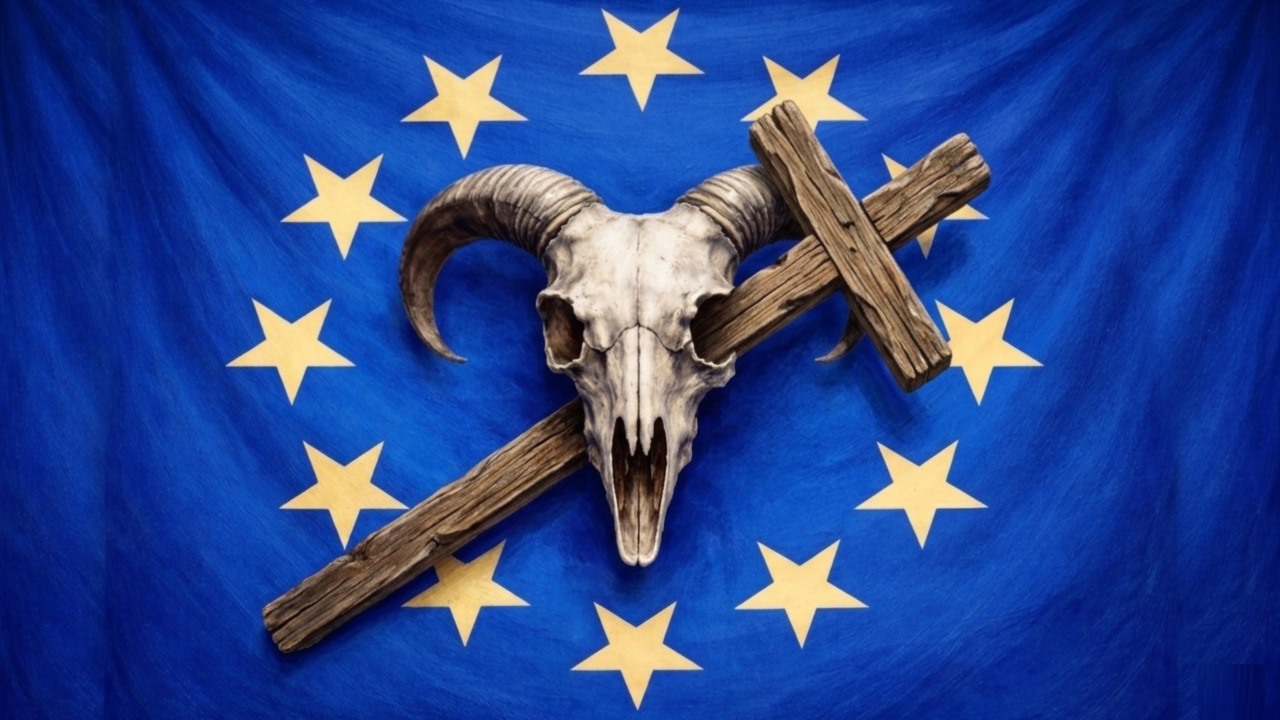
That forces associated with the Priory of Sion were behind the creation of the European Union is evidenced by the EU flag, which depicts a circle of twelve golden stars on a blue background. According to art historian Oleg Nasobin, the blue background symbolizes the Holy Grail - the blue blood of the Merovingian descendants - and the circle of twelve stars symbolizes the 12 Knights of the Round Table of King Arthur.
The Milner Group's possible connection to the Priory of Sion is suggested by the name of the international Round Table movement, founded by this group.
According to the book "The Holy Blood and the Holy Grail" and John Daniel's "Scarlet and the Beast", Jerusalem is to be the capital of the Merovingian's world kingdom. However, since Jerusalem is the capital of the State of Israel, the Priory of Sion takes a hardline anti-Israel stance.
Today, the blood of the Grail is believed to flow in the veins of twelve European royal families. Two members of these dynasties claim the title of King of Jerusalem: Otto von Habsburg (deceased) and Felipe VI, King of Spain.
End of my note.
Although Hugo's project was rejected by Marx and Engels as a "bourgeois idea" (by which they indicated their displeasure at not having come up with it themselves), Engels later declared himself in favour of it, stating that "everything is making in the direction" of a United States of Europe ("Interview with Friedrich Engels", Daily Chronicle, 1 July 1893).
It soon became widespread among Marxists and was taken up by Wilhelm Liebknecht, founder of the Social Democratic Workers' Party of Germany (SOAP) (Liebknecht, 1889). The German Karl Kautsky, the Russian Vladimir Lenin and other European Marxists followed suit in 1911-1914.
In early 1900s Britain, the idea of an international organization was regarded as radical and normally associated with Socialism or Fabianism (Mazower, p. 39). Indeed, it was the Fabian-created Independent Labour Party (ILP) which took it up in 1914 ("Review of the Week", Labour Leader, 1 Oct. 1914), formally adopting it as official party policy in the following year. An early advocate associated with the ILP was Arthur Ponsonby, a leading Liberal who later joined the Labour Party (see Ponsonby).
World War I (1914-19) appears to have put the idea of a united Europe on ice for some time, but it was soon brought back to life by the Left. One of the most influential promoters of a united Europe was the Austrian Socialist, Count Richard Coudenhove-Kalergi, who in 1922 founded the Pan-European Union (PEU).
In the following year Coudenhove-Kalergi wrote a document called Pan-Europa to promote his movement. Among his strongest supporters were Louis van Rothschild, head of the Austrian banking house S. M. van Rothschild & Sohne, and the Polish Socialist Joseph Retinger (de Villemarest, 2004, vol. 2, pp. 18-19).
Austria at the time was a Fabian stronghold run by President Michael Hainisch, a prominent Fabian (DBL, p. 152). Coudenhove-Kalergi and his supporters belonged to the British Fabian Society's international network (de Villemarest, 2004, vol. 2, pp. 20-21).
French Prime Minister Aristide Briand was another strong supporter of Coudenhove-Kalergi. Briand was a leading figure in the French Section of the Second International, a Fabian-dominated Socialist outfit whose first president was British Labour Party leader Arthur Henderson (R. Martin, p. 377).
Briand became Foreign Minister in 1925 and declared his ambition to establish a "United States of Europe". In 1927, Briand was made honorary president of Coudenhove-Kalergi's Pan-European Union. In 1929, he made a speech to the then 27 European members of the League of Nations in which he proposed a federal union. In 1930 he presented to the League a "Memorandum from the French Government on the Organization of a Regime of European federal Union" (Encyclopaedia Britannica, vol. 18, p. 712).
In Britain, the scheme was promoted by Sir (later Lord) Arthur Salter, a former Fabian Society member and a member of the Milner Group (Salter, p. 45; Quigley, 1981, p. 230). Salter later served as head of the economic and financial section of the League of Nations Secretariat and became a leading member of Chatham House. In 1931, he published a collection of papers entitled The United States of Europe in which he explored the building of a federal Europe, declaring that "the United States of Europe must be a political reality" (Booker & North, pp. 16-7).
With the beginning of World War II, the European movement was suppressed on the Continent, forcing its leaders to find refuge in Britain and America. This enabled the movement's Milner-Fabian masterminds to run the European show directly from London, New York and Washington.
In 1940, Coudenhove-Kalergi moved the headquarters of his Pan-European Union (PEU) to New York, where he became co-director of the Post-War European Federation institute at the University of New York. In 1941, he formed the American Committee for a Free and United Europe (ACFUE).
Meanwhile, Coudenhove-Kalergi's collaborator and fellow Fabian, Retinger, was adviser to the Polish government-in-exile in London, where he was in close contact with Anglo-American Milner-Fabian circles, including Chatham House (RIIA), Special Operations Executive (SOE, of which Retinger became a member), MIS, MI6, and their US counterparts, the Council on Foreign Relations (CFR), the Office of Strategic Services (OSS) and later the Central Intelligence Agency (CIA).
Above all, Retinger was responsible for coordinating the foreign ministers of assorted European governments-in-exile, including Paul-Henri Spaak and Paul van Zeeland of Belgium (Dorril, pp. 455 ff.). In 1944, Spaak and his counterparts from Luxembourg and the Netherlands, Joseph Bech and Eelco Nikolaas van Kleffens, signed the London Customs Convention which established the Benelux Customs Union (www.cvce.eu).
After the war, in 1946, van Zeeland established the Independent League for European Cooperation (ILEC) and the European League for Economic Cooperation (ELEC). Retinger was appointed secretary-general of the Leagues and liaison officer with other like-minded committees. His ILEC and ELEC became the driving force behind the European Movement. Retinger and his Leagues were bankrolled by David Astor, son of leading Milner Group members (and friends of the Fabian leadership) Lord and Lady Astor.
Astor was also a disciple of fellow Milnerite Lord Lothian (Philip Kerr), who was regarded as "one of the spiritual fathers of European federalism" (Dorril, pp. 459-60). As editor of The Observer, David Astor orchestrated a propaganda campaign in support of a united Europe "under British leadership" (Dorril, pp. 457-8).
French Europeanist Jean Monnet - belonged to the same Milner-Fabian circles. A former colleague of Arthur Salter in the League of Nations, Monnet used the latter's plans for a supranational European entity to design his own European Coal and Steel Community (ECSC).
The ECSC was established through the April 1951 Treaty of Paris. The Community included Spaak's Benelux Union as well as France, Germany and Italy, and it became operational in 1952. Spaak became president of the Common Assembly of the ECSC.
In 1955, Monnet founded the Action Committee for a United States of Europe (ACUSE) (Booker & North, pp. 58, 70). Among his close collaborators were: Christian Pineau, France's Socialist Foreign Minister; Guy Mollet, French president of the Socialist group on the Council of Europe Consultative Assembly (European Assembly) and Vice-President of the Socialist International; and Paul-Henri Spaak, former president of the European Assembly.
The efforts of the above together with financial and diplomatic backing from their Anglo-American controllers led to the 1957 Treaty of Rome. Spaak and Pineau were among the signatories of the treaty which created the European Economic Community (EEC) a.k.a. "Common Market". In 1967, the EEC became the European Community (EC) and in 1993 the latter became the European Union (EU).
THE EU AND THE MILNER-FABIAN CONSPIRACY
The European Union has been described as a "Franco-German", "German", or even "Nazi" creation. Some seem to believe that Adolph Hitler was the first to use the phrase "United States of Europe" (Mote, p. 122). Such claims are factually incorrect, unnecessarily divisive and (conveniently) misleading.
Patriotism based on disinformation cannot lead to anything good. Instead of saying, "the Germans, the French or the British did this and that", the intelligent approach is to ask, "who were the puppeteers pulling the strings, who were the elite cliques covertly operating behind governments and other key players on the national and international stages?"
A mere glance at the original EU (ECSC) flag logically suggests that the EU was not so much a Franco-German creation as a US inspiration.
While the treaties establishing the European Coal and Steel Community (ECSC) and its successor, the European Economic Community (EEC), were indeed signed by representatives of France, Germany, the Benelux countries and Italy, the covert involvement of Anglo-American interests in European unification has long been exposed by researchers such as F. X. Rebattet, the son of European Movement Secretary-General Georges Rebattet (1962); Richard J. Aldrich of the University of Nottingham (1995); Stephen Dorril of Huddersfield University (2001); and former French intelligence officer Pierre de Villemarest (2004).
Original flag of European Coal and Steel Community (ECSC) representing Europe's 6 united states. (en.wikipedia.org)
Many of the key figures in Europe's federalist movement were neither French nor German: P.-H. Spaak, founder of the Benelux Union - the core of the EC/EU -was a Belgian, Retinger was Polish, Coudenhove-Kalergi was Austrian-Hungarian, etc. On the other hand, almost all, including Frenchmen like Monnet, had close links to London.
• Monnet himself had already been involved with the London-based Allied coordination committees in World War I and, during World War II, was a member of the British Supply Council.
• Monnet's compatriot Guy Mollet was Vice-President of the Socialist International (SI) - a Fabian Society outfit run by Morgan Philips of the Fabian International Bureau (FIB) who also doubled as General Secretary of the British Labour Party. (The SI headquarters are located in London.)
• Incidentally, Mollet was France's keenest supporter of European Union. Paul Henri Spaak was the president of the Consultative Assembly of the Council of Europe, which had been established in London in 1949 and had a strong Fabian representation (Pugh, p. 237).
• Similarly, Retinger had close links to the London Fabian Society and so had many others.
• As noted above, Coudenhove-Kalergi also belonged to Fabian circles.
Apart from London, America's political and financial capitals Washington and New York crop up as common links between the chief protagonists in Europe's federalist saga. America of course financed both the Allied war effort and the reconstruction of Europe after the war. It also financed France's war in Indochina. America therefore naturally played a key role in European developments at the time.
Groups that influenced post-war Germany
The American role was particularly obvious in Germany, which was under Allied occupation between 1945 and 1955, during which time East Germany was run by Soviet Russia while West Germany was run by America in collaboration with Britain and France. Incidentally, this is why Germany was positively not in a position to launch international projects like the European Community, let alone impose such projects on the rest of Europe (see note 1, p. 338).
At the same time, with Europe's largest population and a large economy right in the centre of the Continent, Germany was Central Europe's natural dominant power - whether its neighbours liked it or not. Despite the ravages of war, it had a potentially strong economy based on a powerful industry which was slowly but steadily recovering.
Germany was also the only European country capable of stopping Soviet Russian expansionism and saving Western Europe from Stalinism. As observed by Winston Churchill, without Germany there wouldn't be much "between the white snow of Russia and the white cliffs of Dover". In practical terms, whoever controlled Germany controlled Europe. This is why we must see who controlled Germany and whether they had anything to do with European unification.
The military governors of the British zone of occupation in Germany were: Field Marshall Sir Bernard (later Lord) Montgomery (1945-46); Air Marshall Sholto (later Lord) Douglas (1946-47); and General Sir Brian (later Lord) Robertson (1947-49). More importantly, between July 1945 and October 1951 Britain was a Fabian Socialist state run by Labour Prime Minister and former chairman of the Fabian Society, Clement Attlee, who in 1939 had declared that "Europe must federate or perish" (Attlee; MacKay, p. 42).
The Minister responsible for the British zone of occupation in Germany (1945-47) was none other than Labourite John Hynd, a supporter of the Fabian Society-associated Socialist Vanguard Group (SVG), which campaigned for a European federation and was involved in the reconstruction of political parties in Germany. Similarly, the British Foreign Secretary Ernest Bevin, a Fabian Socialist and the man who held the real power in matters concerning Germany, called for a Western European Union in January 1948 (CAB/129/32, Memorandum by Bevin, 7 Jan. 1949).
Further investigation reveals close links to certain business interests at all stages of the project: Lord Selbourne, the Minister of Economic Warfare (1942-45), was a member of the Milner Group's Inner Circle; General Robertson was a close friend of General Smuts, another member of the Milner Group's Inner Circle.
The Milner Group also dominated the Foreign Office Research and Intelligence Department, the Ministry of Information, the various agencies concerned with economic reconstruction and the British Embassy in Washington. More than a dozen members of the Group were operating in Washington during and after the war (Quigley, 1981, p. 303).
Among the US governors in Germany we may mention General Dwight D. Eisenhower (May-November 1945) and General Lucius D. Clay (1947-49), who were followed by John J. McCloy (194955). Eisenhower's profile immediately puts us on the right track. In 1951 he became Supreme Commander of NATO (which in the words of its first Secretary-General Lord Ismay aimed to "keep the Germans down").
Significantly, Eisenhower became President of the United States in 1953 with Rockefeller backing and surrounded himself with world-federalist members of the Milner-Fabian Council on Foreign Relations (CFR) who were connected to Rockefeller and related Eastern Establishment interests.
Eisenhower's Budget Director, Percival F. Brundage, was cofounder of Federal Union, an organization established before the war to bring about a union of America, Britain and Western Europe. Will. L. Clayton, National Security Training Commissioner, was a co-founder of the Committee for Economic Development (CED) and vice-president of the Atlantic Union Committee, which had the same aims as Federal Union.
The CED had been founded in 1942 by CFR member Paul G. Hoffman of the Rockefeller-controlled Ford Foundation and was a leading member of America's foreign policy establishment. J. D. Zellerbach of Crown Zellerbach Corporation, was Eisenhower's Ambassador to Italy and CED chairman. Leading CFR member John Foster Dulles was Eisenhower's Secretary of State, etc. (Smoot, pp. 51-3, 93-4).
General Clay had close links to the same money interests. On retiring in 1950, he became a leading member of the powerful US Business Advisory Council (BAC), an organization run by his friend Sidney J. Weinberg of the New York investment bank Goldman, Sachs & Co., with close links to the CFR (Smoot, pp. 66, 67-8, 78). Clay later worked for General Motors and became a senior partner with the New York investment bank Lehman Brothers. Clay's adviser was Carl Friedrich, an American academic and advocate of European Union who was involved in the drafting of the German constitution in 1949.
The above facts already enable us to clearly identify two related currents of European federalism or unionism as sources of influence on German politics in the years immediately following the war: British Milner-Fabian circles and US business and banking interests, especially those belonging to America's East Coast-Wall Street Establishment. The latter becomes even clearer if we briefly survey the case of McCloy.
McCloy was a partner at the Rockefeller-associated New York law firm Milbank, Tweed, Hadley & McCloy; member of the 1945 San Francisco Conference which drafted the UN Charter; chairman of the Rockefeller Foundation; chairman of the Rockefeller controlled Chase Manhattan Bank; member of the Rockefeller controlled CFR; and former president of the CFR-controlled World Bank (see also Ch. 6, The UN Scam).
Allied plans for post-war Germany
It is essential to note at this point France's position on post-war Germany. Far from advocating Franco-German unity, President Charles de Gaulle called for the permanent occupation and segmentation of Germany as well as the deportation of millions of Germans to France for slave-labour (MacDonogh, p. 12).
In January 1946, de Gaulle appointed Jean Monnet Plan Commissioner, in which capacity the future "father of the European Coal and Steel Community" (ECSC) was tasked with transforming France's ailing economy. The French plan was based on French exploitation of German coal and steel industries, which were to remain under either French or international control. In other words, as far as the French leadership was concerned, Germany was to become a colony for Allied exploitation.
Initial Anglo-American plans were similar, only more draconic. The Morgenthau Plan of 1944 (agreed on by US President Roosevelt and Prime Minister Churchill) called for the complete dismantling of heavy industry and the transformation of Germany into an agricultural and pastoral economy. Apart from revenge, the reason for this (as stated by Roosevelt and Lord Cherwell) was to eliminate Germany as an economic competitor to Britain (Kimball, pp. 38-39).
Accordingly, General Clay was instructed to "decentralize the structure and administration of the German economy to the maximum possible extent". An extensive deforestation programme was also imposed. Around a million German prisoners of war were handed over to the French as slave-labourers, while others were sent to various Allied countries, including Britain and America (MacDonogh, p. 394). Some were earmarked for use by Churchill on his Chartwell estate in Kent (Soames, pp. 535-6).
The Morgenthau Plan also included systematic mass starvation which claimed over five million victims (Dietrich, pp. 107-8). Roosevelt himself declared that it would be necessary to either castrate the Germans or treat them in such a way so they can't reproduce their own kind (Kimball, p. 96). On his part, Churchill spoke cryptically of ''tragedy on a prodigious scale" unfolding itself behind the Iron Curtain which now divided Europe and of "seventy or eighty millions in a ruined famished condition in the heart of Europe", while insisting that they "deserved" it (Langworth, pp. 142-3).
The tragedy, in fact, was unfolding on both sides of the Iron Curtain: it was officially admitted that, in the British Zone alone, about ten million Germans were kept on starvation rations described as "too much to let you die quickly, too little to let you live long" (Salter, 1946).
However, the international business interests behind the Allied project were keen on using the German economy for their own agenda. While atrocities against the German population continued for several years, Allied policy slowly began to change. The U-turn in Allied thinking had been initiated in December 1945, on the recommendation of Byron Price, the director of the US Office of Censorship. German economy was now to be "geared to a world system" (Ferguson, 2004, p. 77). Like the rest of Europe, Germany was to be used as a market for American goods.
Secretary of State George Marshall in his Harvard speech of 5 June 1947 warned of the "consequences" to the US economy should Europe's alleged need for US goods not be met. Clearly, an economically strong Germany was better suited for this role than one of self-sufficient farmers and shepherds. As a unified government made it easier to control Germany, in July 1946, Marshall's predecessor James Byrnes ("Baruch's man") proposed the unification of the Allied zones of occupation.
This was agreed later that year with Foreign Secretary Ernest Bevin and in January 1947 the American and British zones were merged into Bi-Zone ("Bizonia"). France initially refused to merge its own zone with the other two, but (no doubt remembering who was paying for its war in Indochina) did so in 1949. Tri-Zone, as the entity was first known, was made into a separate state called Federal Republic of Germany (Dinan, pp. 19-20). Its first "capital" was Frankfurt on Main, the US military government's HQ (later moved to Bonn in the British Zone).
Historian John Gimbel observes that the West German government of 1949 was conceived and delivered by the American Army (Ferguson, 2004, p. 76). This is true enough, but it is not the whole story. As the Brookings Institution's Men Who Govern (1967) shows, 86 per cent of US Secretaries of the Army, Navy and Air Force were from a business background or former lawyers with a business practice and this applied to the entire US top federal bureaucracy (Graham Jr., p. 417).
As we have just seen, this same American Army had very close links to certain business and financial interests, indeed, it was controlled by them. Unsurprisingly, the key guidelines for US and UK occupation forces as set out in the official Handbook of Military Government for Germany, included "control of the German Finances" and, particularly, reconstruction of German foreign trade "with priority for the needs of the United Nations" (Kimball, pp. 98-99), i.e., for the needs of the Anglo-American interests who had set up the UN.
In a broader sense, West Germany was the creation of America, a federal republic, in collaboration with Britain, a Fabian Socialist republic masquerading as monarchy, hence "Federal Republic of Germany". In any case, it is indisputable that American officials and their British collaborators - France was not party to Anglo-American planning in Germany -were responsible for the creation of that part of Germany (West Germany) which was involved in the formation of the European Coal and Steel Community (ECSC).
Chancellors of post-war Germany
It goes almost without saying that Germany's new puppet regime, headed by Konrad Adenauer, was all for a united Europe. In fact, Adenauer was an old acquaintance of the new Anglo-American Order. He had already been mayor of Cologne in the 1920s when the British Zone was controlled by the Milner-dominated British Army of the Rhine (BAOR) - Lord Milner himself being War Secretary - which was based at Cologne and commanded by General Sir William Robertson.
As before, Cologne was in the British Zone only that this time round the BAOR was commanded by Robertson's son Brian and Adenauer (who had been on the run under Hitler) was re-appointed mayor of Cologne by the Americans. It is inconceivable that the occupying powers would have picked Adenauer had he not been a collaborator. For all practical purposes, Adenauer was "McCloy's handpicked Chancellor" (Graham Jr., p. 421).
To understand who or what Adenauer really was we only need consider that in 1950, along with Spaak, McCloy and others from the same circle, the "Christian Democrat" Adenauer became an officer of the CFR created World Brotherhood which campaigned for bringing the Western and Communist worlds closer together (Smoot, p. 118).
Similarly, Adenauer's successor, the socialist Willy Brandt, associated with the International Revolutionary Marxist Centre, led by the British socialist Fenner Brockway, also known as the London Bureau, was appointed mayor of occupied West Berlin in 1957. In 1970, he introduced the "Ostpolitik" ("East politics") approach of collaboration with the Moscow-led Eastern Bloc at the instigation of US National Security Adviser, CFR director of foreign policy study and long-time Rockefeller collaborator, Henry Kissinger. This of course was happening precisely at a time when Kissinger's bosses, the Rockefellers, were expanding their interests into Communist countries like Russia and China.
In 1976, Brandt was elected President of the British Fabian created Socialist International, a post he held until 1992.
In 1977, while serving as SI President, Brandt was appointed Chair of the UN "Independent Commission on International Development Issues" (Brandt Commission) by US presidential adviser, World Bank President and CFR director Robert McNamara of the Rockefeller-allied Ford Motor Company. Needless to say, Brandt's Commission was staffed by operatives of the CFR-controlled World Bank ("The Brandt Equation: 21 "1 Century Blueprint for the New Global Economy", Centre for Global Negotiations, 2010; www.brandt2lforum.info).
Helmut Schmidt, Brandt's successor as Chancellor from 1972 to 1982, had been one of the thousands of German POWs held at Wilton Park (set up by Churchill and Bevin) and subjected to intensive indoctrination in "democratic processes" by Milner-Fabian luminaries like Richard Crossman, Bertrand Russell, Lord Beveridge and Lady Astor (www.wiltonpark.org.uk). Nor must we forget the wider Allied "re-education" programme which imposed Allied thinking on the entire German population.
Indeed, the "re-education" was officially referred to as "psychological warfare" and defined as "manipulating a population's beliefs and attitudes for the purpose of evoking desired (i.e., pro-Allied) behaviour responses" (Zunz, pp. 148-9).
This psychological warfare or conditioning continued for many years, indeed decades, after the termination of military hostilities and was conducted by Anglo-American Establishment foundations (like the Ford Foundation which funded the new Free University of Berlin and similar projects) in collaboration with the State Department, CIA, CIA-funded or -created organizations and their British counterparts: the Foreign Office, MI6, British Council, LSE, etc.
There were of course some Germans who called for a united Europe. But they were either collaborators of the new Anglo-American rulers, like Adenauer, or (which amounts to the same thing) representatives of Fabian-dominated International Socialism, like Kurt Schumacher of the Social Democratic Party (SPD). At any rate, their existence does not justify the claim that "the Germans" as a nation wanted, even less that they were responsible for, the creation of the Common Market and resulting European Union. Gen. Clay himself spoke of an Allied determination to continue the control of Germany for many years (Kimball, p. 165).
The evidence clearly shows that the "Federal Republic of Germany" was a front for Anglo-American interests and this is what it remains to this day. Chancellor Angela Merkel has been advised (or directed) by Goldman Sachs chiefs for many years, as well as being a member of Atlantic Bridge, an organization set up after the war by Rockefeller interests for the purpose of remote-controlling West Germany from across the Atlantic.
Churchill as an agent of the Milner Group and the Fabian Society in the Conservative camp
Meanwhile, one of the first to suggest Franco-German cooperation as a basis for a united Europe was former Prime Minister Mr (later Sir) Winston Churchill himself. In a speech at Zurich University in September 1946, Churchill called for the creation of a "United States of Europe from the Atlantic to the Black Sea" adding that the first step to European Union "must be a partnership between France and Germany" (Gilbert, p. 872).
Later that year, Arthur Salter discussed in Parliament Churchill's idea of a united Europe based on Franco-German cooperation, (correctly) pointing out that such cooperation would depend on the British zone, which included the centre of German industry (Salter, p. 302). This was at a time when the new German state had not yet been created and the French were not even dreaming of such a scheme, insisting instead on keeping Germany divided and German industry in French hands.
It may come as a surprise to some to find that Churchill was a prominent member of the European Conspiracy. In fact, Churchill's involvement becomes entirely natural if we have a look at his profile. His father, Lord Randolph, had already been a disciple of "progressive Conservatism" with close links to leading Milnerites. Churchill himself was a Liberal in the 1880s and early 1900s and rejoined the Conservatives only because he felt that the Liberal Party was no longer able to make an impact on British politics (Gilbert, p. 462).
This was true enough: by 1924, the Liberals had been replaced by Labour as Britain's second largest political party. Obviously, for a power-hungry politician like Churchill, a minority party like the Liberals had lost its attraction. But old habits die hard: Churchill's wife remained a Liberal and Churchill himself remained close to Liberal circles for the rest of his life.
More importantly, Churchill was close to the Milner Group and its associates and collaborators, such as Abe Bailey, Lionel Curtis, Lord Astor, Lord Birkenhead, General Smuts, Sir Arthur Salter, Sir Ernest Cassel, the Rothschilds, Sir Henry Strakosch and the American Bernard Baruch. Some of these connections he had inherited from his father.
Ernest Cassel had been a close friend of Lord Randolph, as well as of King Edward VII and later became Churchill's financial supporter (Cannadine, p. 145).
Lord Esher (Reginald Baliol Brett), who was connected with Cassel, also became a personal friend of Churchill's. A co-founder of the Milner Group, Lord Esher was a notorious string-puller who turned down various public posts so that he could carry on operating behind the scenes. He had been a personal friend and political adviser to Queen Victoria and adviser to her son, King Edward VII, and grandson, King George V (Quigley, 1981, pp. 86, 42).
Lord Randolph had also had an "excessively close relationship" with his financier and Milner Group co-founder Lord Nathan ("Natty") Rothschild. Churchill himself remained close to the Rothschilds (Ferguson, 2000, vol. 2, pp. 332-3, 482) and to Rothschild-associated interests like Vickers da Costa, his stockbroker, in which his younger brother Jack Churchill was a partner (Soarnes, p. 348).
In addition, Churchill had a Rothschild bank account (the preserve of friends and associates) and, in 1952, collaborated with the Rothschilds in the formation of the British Newfoundland Development Corporation (BRINCO) (Morton, p. 254; Wilson, pp. 401-2). Even his private secretary John ("Jock") Colville belonged to Rothschild circles, the Colvilles being friends of the Rothschilds, while Jock's brother David later became a Rothschild partner.
Sir Henry Strakosch was a string-puller with close links to British gold-mining and banking interests. He was a very close associate and probably member of the Milner Group, being an old friend of Milnerite Leo Amery from the Boer War and serving as financial adviser to the Bank of England and General Smuts' South African government. He played a prominent role in various Bank of England-Milner Group projects like the Anglo-Austrian (later Anglo-International) Bank, the League of Nations Financial Committee and the Reparations Commission (together with Arthur Salter) and was one of Churchill's financial supporters.
Churchill's close friend Bernard Baruch, an international financier and presidential political adviser, was another notorious plutocrat. He held mining interests in Africa, had been involved in supplying the Anglo-American war effort in WWI together with the Rothschild and Morgan Groups and had a long history of involvement in Milner-Fabian internationalist projects like the League of Nations.
Last but not least, Churchill was the grandson (through his American mother) of Wall Street financier and New York Times shareholder Leonard Walter Jerome, the "King of Wall Street", who was a close associate of Vanderbilt-Morgan interests. It will be recalled that railway magnate William K. Vanderbilt and J. P. Morgan founded the Metropolitan Club of New York which later spawned the Council on Foreign Relations.
Just how close Churchill and his family were to the Anglo-American Establishment is further demonstrated by the fact that Churchill's first cousin, the 9th Duke of Marlborough, married Vanderbilt heiress Consuelo, daughter of W. K. Vanderbilt himself. Similarly, Churchill's daughter Diana married Abe Bailey's son John, etc.
![[]](/img/i/isaew_i/milner-fabian-conspiracy-7/milner-fabian-conspiracy-7-1.png)
![[]](/img/i/isaew_i/milner-fabian-conspiracy-7/milner-fabian-conspiracy-7-2.png)