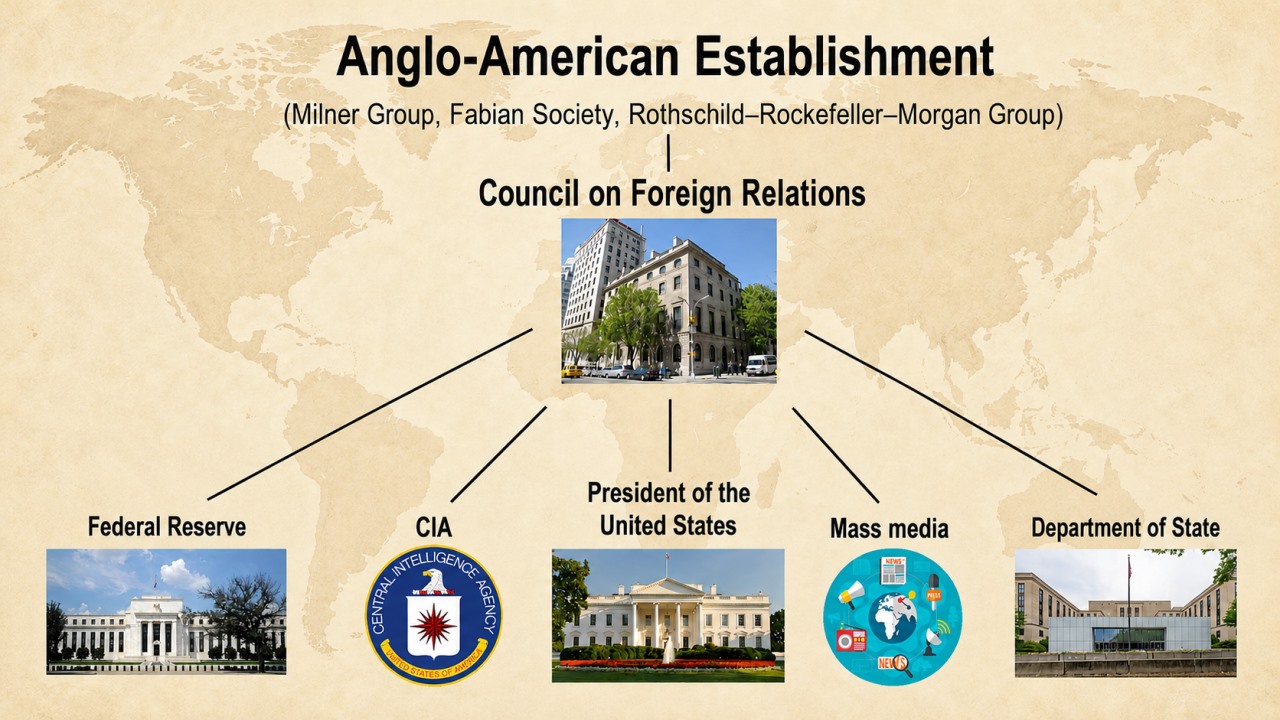
The Council on Foreign Relations (CFR) is the New York-based sister organization of the Royal Institute of International Affairs (Chatham House), established as a continuous conference on international questions affecting the United States (Rockefeller, p. 406).
However, its critics have described it as "invisible government" (Smoot, 1962) and as a "society which believes that one-world rule should be established" (Quigley, 1966).
On 5 February 1891, Cecil Rhodes, the founder of leading diamond company De Beers, formed The Society of the Elect in London, for the purpose of "extending British rule throughout the world" and uniting Great Britain with the United States (Quigley, 1981, pp. 3, 33-38). The Society later came to be known by various names at various times, including "the secret society of Cecil Rhodes", "the Round Table Group", and "the Milner Group" (Quigley, 1981, pp. 3, 4, 39, 311).
Rhodes secret society was clearly intended as an invisible world government. Equally clear is that "British rule" did not mean the rule of the British people, or even of the British government, but the rule of the international financiers behind the Society, who were as much at home in Cape Town, Paris, Frankfurt or New York as they were in the City of London and who intended to pursue their aim of world domination by "secret political and economic influence behind the scenes" (Quigley, 1981, p. 49).
Indeed, the Society achieved the exact opposite of British rule, namely the dissolution of the British Empire and Britains subordination to organizations like the League of Nations (LON), the United Nations (UN) and the European Union (EU), representing (not very British) international money interests.
How this came about is suggested among other things by the composition of the Societys leadership. Its inner core ("Circle of Initiates") included:
• and Alfred Milner (later Lord), private secretary to former Bank of England director Lord Goschen. Milner also became a director of the Rothschild controlled mining company Rio Tinto. Although he described himself as an "English nationalist", Milner was in fact a notorious Socialist (Quigley, 1981; Sutton, 1974).
Birth of the Morgan Group, the American equivalent of the Milner Group
In a parallel movement across the Atlantic, on 20 February 1891, the American John Pierpont Morgan founded the elite Metropolitan Club of New York with headquarters on the 60th Street. Morgan was a partner and later head of Americas No. 1 private investment bank Drexel, Morgan & Co. (later J. P. Morgan & Co.) of New York, with branches in London and Paris. He was also an agent for European investment in the USA and Rothschild representative with links to the Rothschilds dating from 1835 (Mullins, p. 54).
The Metropolitans original members included railway magnate William K. Vanderbilt and James Alfred Roosevelt of the investment bank Roosevelt & Son, an uncle of US President Theodore Roosevelt (www.metropolitanclubnyc.org). The Roosevelt's had long-standing close links to the Morgan, Vanderbilt and Astor groups. Emlen Roosevelt of the Astor National Bank of New York, which was controlled by Morgan partner Thomas W. Lamont, was Theodore Roosevelts financial adviser (Burch, Jr., vol. 2, p. 188; vol. 3, p. 21).
Other key figures associated with British interests were Jacob H. Schiff and August Belmont.
Jacob Schiff was the head of Americas No. 2 private investment bank Kuhn, Loeb & Co. of New York, and a Rothschild representative. Schiff's father, Moses, had already been an associate of the Rothschild banking firm in Frankfurt, Germany (Encyclopaedia Judaica, vol. 14, p. 961) and his familys close connections with the Rothschilds went back to the 18th century (Mullins, pp. 57, 87).
August Belmont was the head of the private investment bank August Belmont & Co. of New York, and a Rothschild representative. His father, August (Schnberg) Belmont Sr., had been an employee of the Rothschilds banking firm in Frankfurt, and a representative of their interests in the US as well as Democratic Party Chairman (Encyclopaedia Judaica, vol. 14, p. 342; Ferguson, 2000, vol. 2. pp. 65-7).
The Birth of the Anglo-American Establishment
J. P. Morgan and associates, August Belmont, Jacob Schiff, etc., belonged to the so-called "Eastern Establishment" (Quigley, 1966, p. 950), Americas financial and academic elite based on the East Coast, especially in New York and Washington, D.C. The Morgan Group, in particular, formed the New York counterpart to Londons Milner Group (Quigley, 1966, p. 953) and the two groups formed part of what Carroll Quigley has called "the Anglo-American Establishment" (pdf, html).
It should be noted that, given the establishments close connections with France (through the Rothschild, Lazard, Morgan and Fabian groups), a more accurate denomination would be "Anglo-Franco-American Establishment". For the sake of convenience, however, the present study preserves Professor Quigleys phrase.
Morgan Group Network of Organizations
Like the Milner Group in Britain, the Morgan Group created a network of interlocking organizations connected with international relations. Among these were the:
• Pilgrims Society, with branches in London and New York established in 1902 and 1903, respectively, by Schiff and Belmont in collaboration with New York lawyer Lindsay Russell (whose firm Alexander & Colby acted as counsel for the Morgans Southern Railway Co.);
• and the foreign-policy think tank Carnegie Endowment for International Peace (CEIP), established in 1910 by former steel magnate Andrew Carnegie (who had sold his business to Rothschild agent J. P. Morgan) with Elihu Root as president.
In June 1918, the Metropolitan formed an informal group called the Council on Foreign Affairs which held regular meetings at its 60" Street premises to discuss international relations. The Councils chairman was Lindsay Russell, president of the Japan Society. The Councils honorary chairman was CEIP president Elihu Root. The board of directors included Oscar S. Straus and former US Ambassador to Turkey Henry Morgenthau, Sr. who had been on Woodrow Wilsons 1912 presidential campaign team ("Plan International Forum", New York Times, 4 Jun. 1918).
Establishment of the Anglo-American Institute of International Relations
During the 1919 Peace Conference of Paris, the Society of the Elect, now led by Rhodes friend and successor Lord Milner and hence known as "the Milner Group", in collaboration with Fabian Society members and the Morgan Group conceived an Anglo-American organization called the Institute of International Affairs.
The Institute was organized under the leadership of Lionel Curtis, a prominent member of the Milner Group. Among Fabians involved were R. H. Tawney, John Maynard Keynes (Martin, p. 175) and Philip Noel-Baker (Quigley, 1981, p. 183), as well as Fabian collaborators/sympathizers like LSE Professor Arnold J. Toynbee who became Chatham House Director of Studies and Lord Astor (son of the 1st Lord Astor), a leading Milnerite who was also a friend of the Fabian leadership.
The Institute's American group included brothers John Foster Dulles and Allen Dulles of the Wall Street law firm Sullivan & Cromwell (who were nephews of President Wilsons Secretary of State, Robert Lansing), Christian Herter of the US State Department and General Tasker Bliss, US representative, Inter-Allied Supreme War Council.
Among those providing funds to the Institute were: J. P. Morgan & Co., the Carnegie Trust and J. D. Rockefeller, as well as various institutions with Milner Group members on their board of directors, such as the US car maker Ford Motor Company, the Bank of England, Lazard Brothers & Co. of London and N. M. Rothschild & Sons (Quigley, 1981, p. 190).
The creation of Chatham House and the CFR
The British branch of the Institute was founded in London in 1920 and became the Royal Institute of International Affairs (RIIA or Chatham House) in 1926. It later became known as Chatham House after the building housing its headquarters.
The American branch of the Institute initially failed to take off due to the US Senates opposition to the internationalist schemes of President Woodrow Wilson, the Institutes chief American supporter. But in July 1921, those associated with the Anglo-American Institute of International Affairs merged with (according to Quigley, 1981, p. 191, "took over") the Morgan Groups Council on Foreign Affairs. The new organization was named the Council on Foreign Relations (CFR) and held the first meeting of its directors on 28 September 1921.
The CFRs current headquarters at Harold Pratt House, 58 East 68th Street, New York City, was acquired in 1929 with funds provided by the Rockefellers (Smoot, p. 7).
Influential members of the CFR
As conceded by leading CFR member David Rockefeller, the CFRs proceedings were dominated by New York businessmen, bankers and lawyers (Rockefeller, p. 407). A selected list of 1921 founding directors makes it clear whose interests they represented:
Honorary president: Elihu Root, a Morgan lawyer and front man (Quigley, 1966, p. 53). As already noted, Root was president of the Carnegie Endowment for International Peace and former honorary chairman of Morgans Council on Foreign Affairs.
President:John W. Davis, another Morgan man (Quigley, 1966, p. 53). He was former Ambassador to Britain and partner at the New York law firm Davis, Polk & Wardwell, a Morgan representative, as well as a trustee of the Rockefeller Foundation (Collier, p. 134).
Vice-president:Paul D. Cravath, of the New York law firm Cravath, de Gersdorff, Swain & Wood, a Kuhn, Loeb representative.
Secretary & treasurer:Edwin F. Gay, former Harvard Professor of Economic History and president of the New York Evening Post.
[Harvard was a Morgan-controlled university. J. P. himself had been a generous donor and received an honorary Master of Arts degree from Harvard. Harvard president Charles W. Eliot backed Morgans candidate Wilson for presidency in 1912. J. P. Morgan partner Thomas W. Lamont was the chairman of the Harvard Endowment Fund Committee and member of the board of directors of Harvards daily paper, The Crimson.]
The SMO also included such influential figures as:
John Huston Finley, former New York State Commissioner of Education and associate editor of the Morgan-controlled New York Times.
[The Milner Group also controlled the International Conciliation, the Herald Tribune, the Christian Science Monitor and the Washington Post (Quigley, 1966, p. 953); in Britain, it controlled or had influence on The Times, The Round Table, The Economist, the Spectator and other publications (Quigley, 1981, pp. 138, 161, 260).]
Whitney H. Shepardson (CFR treasurer, 1933-42), a Milnerite and Rhodes scholar, member of Wilsons team at the 1919 Paris Peace Conference, who later became head of the Office of Strategic Services (OSS) Secret Intelligence Branch [* from which the CIA was created after the war].
Frank L. Polk (CFR vice-president, 1940-43), partner of Davis, Polk & Wardwell, later director of Morgan-controlled Chase National Bank.
Isaiah Bowman (CFR vice-president, 1945-49), director of the American Geographical Society and former member of the executive committee of President Wilsons Inquiry.
[Wilson himself was a Morgan front man. In 1902, he became President of Princeton University with the help of his old classmate and director of the Morgan-controlled National City Bank, Cleveland Dodge (Sutton, 1995, p. 82) and had a private dinner with the Morgans at his home to celebrate his installation as president next day.
Princeton University, controlled by the Milner Group, later established the Institute for Advanced Study, similar to All Souls College at Oxford University (Quigley, 1966, p. 953).
Wilson supported Morgan during the 1907 financial crisis and Morgan, along with his Rockefeller-Schiff associates, backed Wilsons 1912 presidential campaign. The largest single contributor to the Wilson campaign was Cleveland Dodge (Sutton, 1995, p. 83). Another Morgan associate who backed Wilson was Colonel George Harvey of Harpers Weekly (Smith, p. 41).]
Bowman was also a member of the British Royal Geographical Society (Parmar, p. 40) and geographical societies on both sides of the Atlantic were involved in "exploration", especially in connection with discovering and obtaining information on natural resources like oil.
Paul Moritz Warburg, of Kuhn, Loeb, member and later president of the Federal Reserve Board Advisory Council (see below).
Otto H. Kahn, of Kuhn, Loeb - from CFR Historical Roster of Directors and Officers (Smoot, pp. 153-5; www.cfr.org).
The above list clearly exposes the CFR as an operation created and dominated by the Milner-Morgan Group and other Rothschild associates.
The Warburgs, of Hamburg, Germany, had close connections with the Rothschilds going back to the early 1800s. In the 1890s, Max Warburg did his apprenticeship at N. M. Rothschild in London before becoming director of his familys banking house M. M. Warburg (Ferguson, 2000, vol. 2, p. 234). In 1902, his brother Paul Moritz moved to New York where he became a partner at Kuhn, Loeb, which was run by his brother-in-law Jacob Schiff, a Rothschild agent.
J. P. Morgan and Kuhn, Loeb were also long-time Rothschild representatives. The Rothschilds remained close to the Morgans and Kuhn, Loeb long after the creation of the CFR.
In 1938, Louis von Rothschild of S. M. von Rothschild & Sohne of Vienna, transferred the rights of disposal over all his Austrian assets to Kuhn, Loeb (Ferguson, 2000, vol. 2, p. 471). In the 1940s and 50s, Edmund ("Eddy") and Leopold ("Leo") de Rothschild and Jacob (later Lord) Rothschild of London did their apprenticeship at (Morgan-controlled) Guaranty Trust, Morgan Stanley and Kuhn, Loeb (Ferguson, 2000, vol. 2, pp. 480, 483).
The CFR has always had a large number of J. P. Morgan & Co. partners, associates and employees on its board of directors and its relationship with its British counterpart Chatham House (RIIA) has been very close (Quigley, 1981, p. 191).
Its main financial supporters have been various Rockefeller foundations and funds as well as the Rockefeller-associated Carnegie and Ford foundations which between them control enormous resources (Kutz, 1974). Their financial contributions have enabled the CFR to become a very powerful organization (Smoot, pp. 7, 34).
THE CFR AND SOCIALISM
The Milnerite creators of the CFR aimed to establish a Socialist style dictatorship headed by a self-appointed administrative or technocratic elite (the Milner Group itself) (Quigley, 1981, pp. 130-1). This aim is hinted at in Colonel Edward M. Houses book, "Philip Dru Administrator: A Story for Tomorrow 1920-1935" (1912).
Edward M. House, intimate friend and adviser to President Wilson was a left-wing radical who believed that the American Constitution was "thoroughly outdated" and should be scrapped (Smith, p. 23). House and his collaborators organized a meeting during the 1919 Paris Peace Conference, which led to the creation of the CFR and Chatham House.
Their sponsorship of Socialism and revolution, therefore, was a logical consequence of their aims (if the Milner Group ever opposed Socialism, it was only the kind over which they had no control).
The Milner Group and the Fabian Society are financing the revolution in Russia
During the Russo-Japanese War of 1904-05, the Rothschilds US representative, Jacob Schiff and his bank, Kuhn, Loeb, sided with the Japanese, providing them with a loan of $200 million (41 million) (Encyclopaedia Judaica, vol. 14, p. 961). The Rothschilds, who specialized in government loans, also participated in this loan (Ferguson, 2000, vol. 2. p. 396). At the same time, Schiff and the Rothschilds blocked loans to Russia. The overall result was that in 1905 Russia was plunged into revolution.
In 1907, Lord Rothschild (of Rothschild, London) and his cousin Edouard de Rothschild (of Rothschild Frres, Paris), issued similar loans to Japan, one of them in the amount of 23 million ($112 million) (Smethurst; Ferguson, 2000, vol. 2, p. 396).
As noted earlier, while Schiff and the Rothschilds provided loans to Japan, industrialist and millionaire Joseph Fels of the Fabian Society - an organization with close links to the Rothschilds - provided a substantial loan, in addition to pocket money, to Lenin, Trotsky and their Russian Social Democratic Labour Party (later Communist Party) during their 1907 London conference (Rappaport, pp. 153-4; Martin, pp. 29, 161; Cole, p. 113, see also Joseph and Mary Fels Papers, The Historical Society of Pennsylvania, Collection 1953; www.hsp.org).
In February 1917, the Tsar was overthrown by the revolutionary government of Alexander Kerensky (a leading member of Russias Socialist-Revolutionary Party) and the way was paved for Lenins Communist gang to take over later that year.
Historical evidence shows that Schiff had something to do with this outcome. He had financed a revolutionary propaganda campaign against Russias legitimate Tsarist government (through the New York Society of the Friends of Russian Freedom), funded armed groups in Russia and supported Alexander Kerenskys revolutionary government with a substantial loan (Encyclopaedia Judaica, vol. 14, p. 961). In fact, the Rothschilds themselves loaned a million roubles to Kerenskys revolutionary government in 1917 (Ferguson, 2000, vol. 2. p. 448).
Professor Sutton (1974, p. 197) seems to believe that Schiff was "not interested in supporting the Kerensky Liberty Loan". The evidence (see above) shows that Schiff did loan money to Kerensky and that the Rothschilds themselves participated in Kerenskys Liberty Loan as well as in the earlier Japan loans which contributed to the fall of the Tsars.
Moreover, in March 1917, Schiff sent a message of deep regret for his inability to celebrate with the Society of the Friends of Russian Freedom (SFRF) "the reward of what we had hoped and striven for these long years". The SFRF was celebrating the Russian Revolution at Carnegie Hall.
Schiffs message was read out by George Kennan (cousin of historian George F. Kennan) who had close links to Kerenskys Socialist-Revolutionary Party and was a leading SFRF member. Earlier during the meeting, Kennan related how the Schiff-funded SFRF had spread "the gospel of the Russian revolutionists" among thousands of members of the Russian forces ("Pacifists Pester Till Mayor Calls Them Traitors", NYT, 24 Mar. 1917).
For British involvement in see note at end of chapter. [*]
[*] Му note.
The role of the British ruling class in organizing the socialist and communist revolutions in Russia in 1917 is detailed in Richard Poe's study, "How the British Invented Communism" (2023).
End of my note.
The Rothschilds other representatives, the Morgan Group, in collaboration with the Rockefellers and their associates were similarly involved in left-wing projects like:
• and the Russian Revolution in February and October 1917 (Sutton, 1974, pp. 51, 125).
In November 1917, William Boyce Thompson of the Federal Reserve Bank of New York (controlled by the Rockefeller-Kuhn Loeb and Morgan groups through their National City and First National Banks) contributed $1 million to the Russian Communist leadership (Sutton, 1974, pp. 18, 125, 170).
Thompsons American Red Cross Mission to Russia, Charles R. Crane of Westinghouse Electric (financed by Kuhn Loeb & Co), the Morgan-controlled Guaranty Trust Co. and others were all involved in Russia at various times during and after the 1917 Revolution (Sutton, 1974, pp. 171; 26-7, 193; 170).
The Rockefellers Standard Oil and the Morgan-controlled Chase National Bank (taken over by the Rockefellers in 1930) conducted business with Communist Russia since the 1917 Revolution (de Villemarest 1996, p. 242).
The above activities, including Schiffs creation in 1907 of the Japan Society, must be seen as the background on which the CFR-RIIA global network emerged.
Woodrow Wilson, US President from 1913 to 1921, and his friend and adviser Colonel House, who according to some sources was an agent for the London House of Rothschild with which he was linked through banking and cotton interests (Martin, p. 160), were instrumental in the formation of the Anglo-American Institute of International Affairs.
Wilson was a Democrat and political theorist who advocated centralized power and who believed that "in fundamental theory socialism and democracy are almost if not quite one and the same" ("Socialism and Democracy", 1887). As pointed out by Rose Martin, Wilsons book, The New Freedom, sought to equate the Democratic Party with the Social democracy of the British Fabians (Martin., p. 149). Morgan-Rockefeller-Schiff backing for Wilson clearly exposes their left-wing political allegiance.
The original Council on Foreign Affairs (later CFR) itself was formed just weeks after the creation by the same interests, of the American League to Aid and Cooperate with Russia (1 May 1918) which aimed to do business with Lenins and Trotskys Communist regime (Sutton, 1974, p. 154). Its honorary chairman was Morgan man Elihu Root, president of the pro-Socialist CEIP and head of the 1917 Root Mission to Russia, while Oscar S. Straus, vice-president of the American League to Aid and Cooperate with Russia, was a member of its board of directors.
The Council on Foreign Relations's left-wing political orientation
The CFRs political orientation is indicated among other things by statements such as that of CFR Chairman Peter G. Peterson who in the Councils 1997 annual report conceded that there was "a kernel of truth" to the charge that the CFR was an organization of "New York liberal elite" (Marrs, p. 33).
How liberal, i.e., left-wing, the organization is, emerges from the fact that left-winger Hamilton Fish Armstrong was editor of the CFR journal Foreign Affairs, while his close friend, Fabian Socialist Walter Lippmann, was one of the journals first contributors and CFR foreign-policy expert (Steel, pp. 204, 236).
In particular, David Rockefeller, Americas chief Corporate Socialist, wrote a thesis on Fabian Socialism at Harvard and spent his second post-graduate year at the Fabian London School of Economics (Rockefeller, p. 75). From 1949, he has been a director, chairman (1970) and honorary chairman (1985) of the CFR.
The same interests, represented by the Laura Spelman Rockefeller Memorial, the Rockefeller Foundation and associated outfits, have also funded influential Anglo-American left-wing institutions and organizations like the Fabian Societys London School of Economics which alone received millions of dollars, for which reason it became known as "Rockefellers baby" (Martin, p. 309; Rockefeller, p. 81; Dahrendorf, p. 164).
With all their support for Socialism, ultimate power in the Milnerite scheme was of course to remain in the hands of the international financiers (Sutton, 1974, p. 175) whose fortunes, power and influence were above state control and who professed social "equality". This has in fact been the case throughout modern history, including in Communist Russia where Milnerite interests were allowed to carry on doing business as usual (see here, p. 199).
THE CFR AND THE FEDERAL RESERVE
There has been much speculation about the links between the US central banking or Federal Reserve system (FRS) and the Anglo-American Establishment. Some authors have sought to settle the matter by insisting that the Federal Reserve is a "U.S. government institution" which is "not owned by any private entities" and that "the Rothschilds have nothing to do with it" (Foxman, p. 138).
However, this assessment is not entirely accurate.
In the first instance, as pointed out by the economist Professor Antony Sutton on the evidence of Federal Reserve vice-chairman Alan Blinder, decisions taken by the Fed "cannot be changed by Government or anyone else", in which case the Fed cannot really be a "government institution" (Sutton, 1995, p. 114).
Secondly, Sutton also points out that "the Federal Reserve is a private system with private stockholders" (Sutton, 1995, p. 66).
Indeed, the Federal Reserve may or may not be a government institution, but it is a well-known fact that shares of the twelve Federal Reserve Banks which make up the system are owned by member banks (Fox & others, p. 12) or, as stated by the FR website, "the reserve banks issue shares of stock to member banks" (http://www.federalreserve.gov/fags/about_14986.htm).
From inception, these member banks, e.g., National City and First National (later Citibank) and Chase National (later JPMorgan Chase), New York, which elect the directors of the regional FR banks, were controlled by private interests such as the Morgan and Rockefeller groups and continue to be controlled by them. Even taking into account that member banks have only one vote in the election of regional FR bank directors, their influence remains considerable.
In 1912, an official investigation ("Pujo Committee") found that J. P. Morgan & Co. partners held 72 directorships in 47 of the countrys largest corporations in addition to owning large shares of stock in the National City and First National banks, which in turn owned stock in other large banks (de Saint-Phalle, p. 52).
It goes without saying that smaller corporations are influenced by the larger ones which dominate the industry and with which they come into direct or indirect contact. Given the growing concentration of power in the hands of a few large corporations, this influence can only have increased over time.
Thirdly, as regards the Rothschild connection, the fact is that the very idea of a central bank was a European concept and that the US Federal Reserve was conceived on the model of privately-owned European institutions, such as the Bank of England and the German Reichsbank and following discussions with officials of those institutions (Broz, pp. 175-6; Sutton, 1995, p. 76).
As is well known, the Bank of England had close historical connections with the Rothschilds. Moreover, the Rothschilds had a well-documented history of involvement in various official initiatives designed to "stabilize" American finances in the 1870s and 1890s (Ferguson, 2000, vol. 2, p. 348; Bernstein, p. 275). It therefore seems counterintuitive that the Rothschilds should have had "nothing to do" with the Federal Reserve project.
Interestingly, a Federal Bank was founded in New York in 1902 by the brothers David and Louis Rothschild. It was closed down by the government only two years later and the exact identity of the interests behind the operation or, indeed its true objectives, remains a mystery ("Federal Bank Closed And Inquiry Started", NYT, 15 Apr. 1904).
What is certain is that the European Rothschilds operated in America and elsewhere through agents and partners they knew and trusted, like the Belmonts, the Schiffs, the Warburgs and the Morgans (Ferguson, 2000, vol. 2, pp. 115, 348, 396). These Rothschild agents and partners were involved in the Federal Reserve project at all stages.
For example, Jacob Schiff of Kuhn, Loeb and Paul Warburg, also of Kuhn, Loeb, called for a central bank in 1907. Warburg, in particular, was a staunch advocate of a central banking system and one of the chief architects of legislation establishing the Federal Reserve (Encyclopaedia Judaica, vol. 16, p. 282; Sutton, 1995, p. 79).
It was Warburg and his collaborator Benjamin Strong, vice-president of the Morgan-controlled Bankers Trust of New York, who as advisers to Senator Nelson Aldrich (John D. Rockefellers father in law) persuaded the latter of the "need" for a centralized system (Broz, p. 175).
As noted above, President Woodrow Wilsons adviser, Colonel House himself, who was involved in the Federal Reserve Act of 1913, has been identified by historians as a Rothschild agent (Martin, p. 160). House also selected the first Federal Reserve Board, including Rothschild associate Paul Warburg (Smith, p. 78).
In their turn, Rothschild associates Morgan and Kuhn, Loeb nominated Benjamin Strong for the post of first governor of the Federal Reserve Bank of New York (Quigley, 1966, p. 326), which later became the dominant bank in the Federal Reserve.
Influence on or control of the FRS by private interests must be beyond dispute since representatives of the said interests are sitting on the bodies which control it, i.e.: